Business Operations
Fragrance Product Cost Breakdown: Where Your Money Actually Goes
You receive three quotes for the same 200g scented candle in a glass jar. One says $2.10 per unit. Another says $4.85. The third lands at $3.40 but with a 5,000-unit minimum. Without understanding what drives these numbers, you are negotiating blind. You cannot tell whether the low quote cuts corners on fragrance load or whether the high quote simply includes better packaging. This uncertainty costs procurement teams weeks of back-and-forth sampling and, in worst cases, leads to margin erosion after launch.
The reality is that fragrance product manufacturing cost follows a predictable structure. Whether you are sourcing reed diffusers, scented candles, essential oil blends, or car fragrances from Chinese OEM factories, roughly 60-75% of your unit cost sits in three line items: fragrance oil, vessel or container, and packaging. The remainder covers labor, overhead, compliance, and margin. This guide dissects each layer of the fragrance product BOM (bill of materials) with real cost ranges so you can benchmark quotes, identify savings levers, and build accurate landed-cost models before you commit to a production run.
Raw Materials: Fragrance Oil and Wax Base
Fragrance oil is the single most variable cost component. A standard 200g soy candle uses 16-20g of fragrance oil at an 8-10% load. Oil pricing spans an enormous range depending on origin and complexity:
- Economy-grade oils (single-note, synthetic): $8-$15 per kg. Suitable for car fresheners or high-volume promotional items where scent nuance is secondary.
- Mid-range compound oils (multi-note blends, partial naturals): $18-$35 per kg. The sweet spot for most private-label candle and diffuser brands targeting retail price points of $18-$35.
- Premium and fine-fragrance-grade oils (high natural content, IFRA-compliant complex accords): $45-$120+ per kg. Used by luxury brands where scent is the primary differentiator.
For a 200g candle at 10% load, fragrance oil alone costs between $0.13 (economy) and $2.40 (premium). That single decision can swing your total unit cost by over $2.
The wax or carrier base is more stable in price. Soy wax runs $1.80-$2.80 per kg, paraffin $1.20-$1.90 per kg, and coconut-soy blends $2.50-$3.80 per kg. A 200g candle uses approximately 180g of wax, adding $0.22-$0.68 to the BOM. For reed diffusers, the carrier is typically DPG (dipropylene glycol) or isopropyl myristate at $1.50-$3.00 per kg, with a 100ml diffuser using roughly 70-80ml of carrier base.
Vessel, Container, and Closure Costs
The container is often the second-largest line item and the one buyers most frequently underestimate.
| Product Type | Vessel Spec | Unit Cost Range (FOB) | Notes |
|---|---|---|---|
| Scented candle | 200g amber glass jar + metal lid | $0.45-$0.90 | Lid style and glass thickness drive variance |
| Scented candle | 300g matte ceramic vessel | $1.10-$2.20 | Glaze and firing quality affect price |
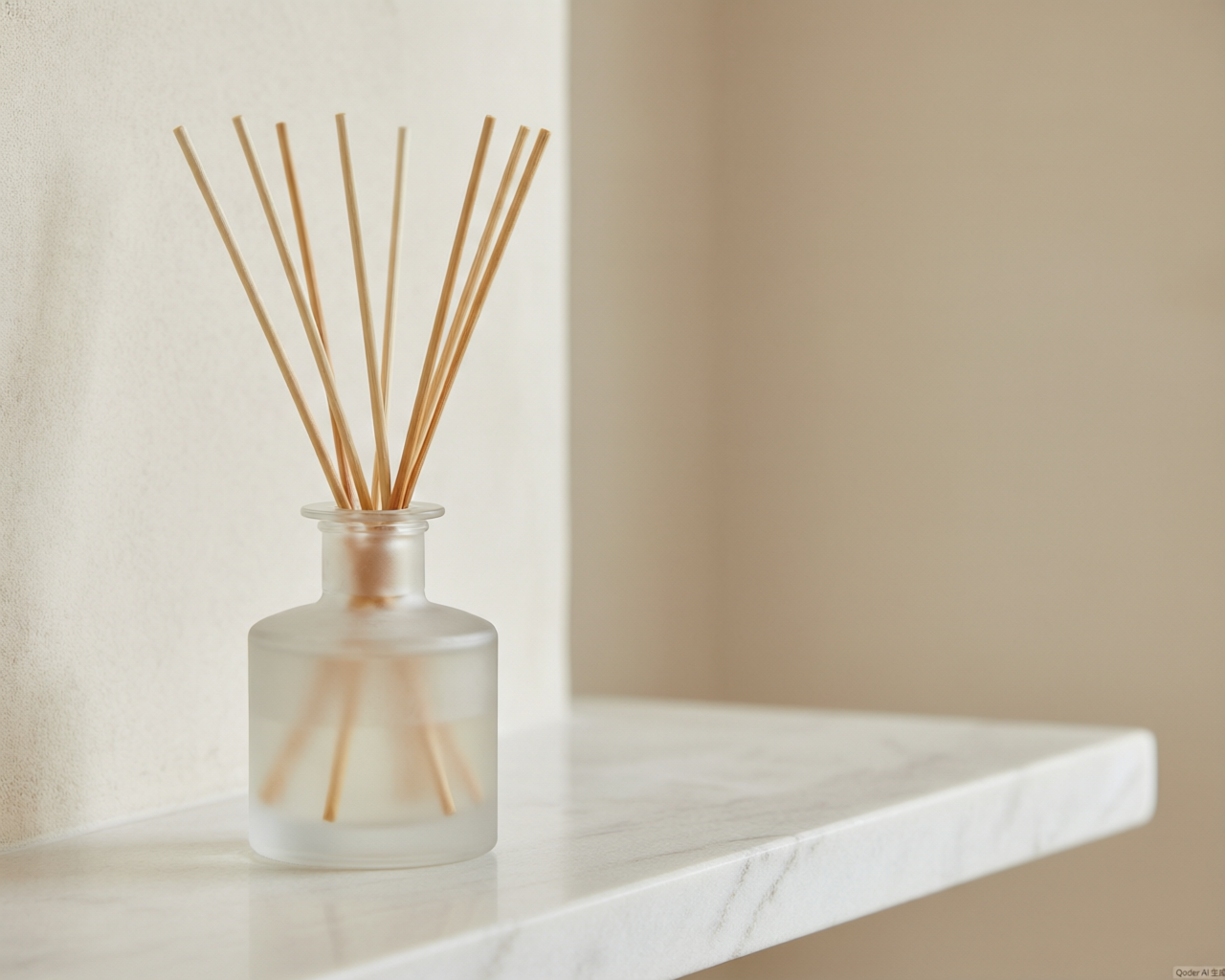
| Reed diffuser | 150ml frosted glass bottle + collar | $0.55-$1.10 | Includes cap and neck ring |
| Car fragrance | ABS plastic clip housing | $0.30-$0.75 | Mold cost amortized over run |
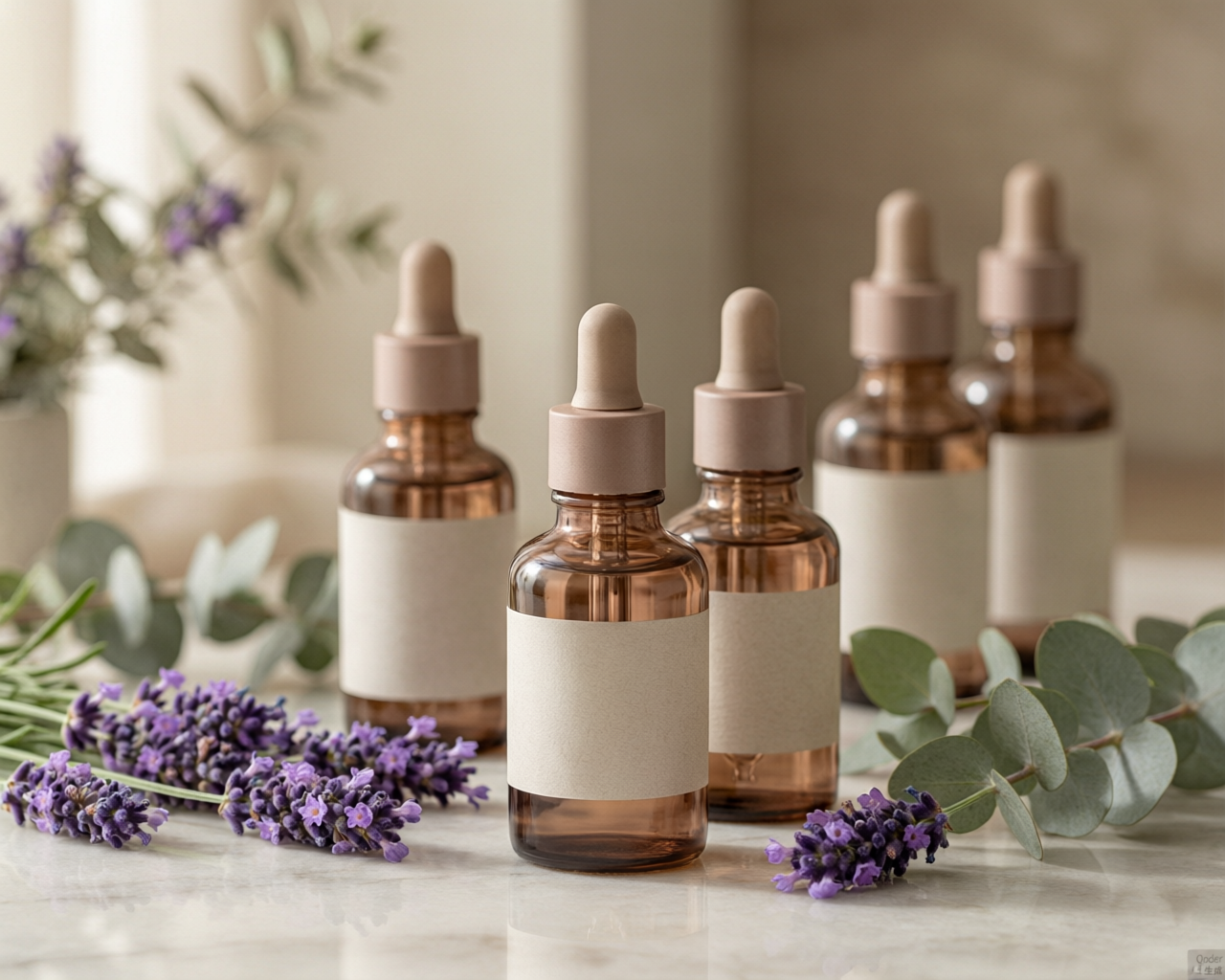
| Essential oil | 10ml amber glass bottle + dropper | $0.25-$0.55 | Dropper mechanism quality varies |
Custom molds for unique vessel shapes add $800-$3,500 in one-time tooling. If your annual volume is under 10,000 units, stick with the factory’s existing mold library to avoid amortizing tooling across too few units. A $2,000 mold spread over 5,000 units adds $0.40 per piece; spread over 50,000 units, it becomes negligible at $0.04.
Packaging and Labeling
Packaging typically represents 12-20% of total unit cost for mid-range products. Key cost drivers:
- Rigid gift boxes (magnetic closure, foam insert): $0.60-$1.50 per unit at 3,000+ MOQ. This is standard for candles retailing above $25.
- Folding cartons (350gsm C1S, spot UV): $0.18-$0.45 per unit. Cost-effective for diffusers and oil sets.
- Labels and sleeves (full-color, textured stock): $0.04-$0.15 per unit. Pressure-sensitive labels are cheapest; shrink sleeves add $0.03-$0.06 but provide 360-degree coverage.
- Inner protection (EVA foam, corrugated inserts, tissue paper): $0.08-$0.30 per unit. Glass products require adequate protection to keep breakage below 1.5% in transit.
If you are building a multi-SKU line, standardize your box dimensions across products. Factories price packaging by sheet yield; running three SKUs in one box size versus three different sizes can reduce per-unit packaging cost by 15-25% through combined print runs.
Labor, Overhead, and Factory Margin
Chinese fragrance manufacturing labor costs have risen steadily but remain competitive. For a standard candle-pouring line:
- Direct labor (pouring, wick setting, assembly): $0.15-$0.35 per unit depending on automation level. Hand-poured lines cost more but allow smaller batch flexibility.
- Quality control and inspection (in-line QC, AQL sampling): $0.05-$0.12 per unit, often bundled into overhead.
- Factory overhead (facility, utilities, equipment depreciation): $0.10-$0.25 per unit.
- Factory margin: Typically 12-20% on FOB price for established OEM relationships. Below 10% margin, expect compromised material sourcing or rushed production scheduling.
When evaluating candle manufacturing cost quotes, ask the factory to separate material pass-through from conversion cost. Transparent suppliers will provide a BOM breakdown showing each component. If a factory refuses to itemize, treat that as a risk signal.
MOQ, Volume Tiers, and Their Impact on Unit Cost
Order volume is the fastest lever for cost reduction. Most Chinese fragrance OEM factories structure pricing in tiers:
- 500-1,000 units: Expect 25-40% premium over base pricing. Factories absorb setup costs (line changeover, fragrance batching, label plate fees) across fewer units.
- 3,000-5,000 units: Standard pricing tier. Most factories quote their “catalog price” at this volume.
- 10,000-20,000 units: 8-15% discount below standard. You gain leverage on packaging print runs and can negotiate dedicated production slots.
- 50,000+ units: 15-25% below standard. At this volume, request annual pricing agreements with raw material index clauses to lock in costs.
For diffuser cost analysis specifically, note that reed sticks and fiber sticks have their own volume economics. Natural rattan reeds cost $0.08-$0.15 per stick; fiber reeds cost $0.03-$0.07. A 10-stick set adds $0.30-$1.50 depending on material choice and length.
Hidden Costs Buyers Overlook
The FOB unit price is not your landed cost. Budget for these frequently missed items:
- Sampling and prototyping: $50-$200 per sample round, with 2-3 rounds typical before production approval. Timeline: 7-14 days per round.
- Compliance and testing: IFRA certification, CLP labeling for EU, California Prop 65 screening, and MSDS documentation. Budget $300-$800 per SKU for a full compliance package.
- Freight and insurance: Sea freight from Shenzhen or Ningbo to US West Coast runs $2,500-$5,500 per 20ft container (2025-2026 rates). A 20ft container holds approximately 8,000-12,000 candle units depending on packaging volume.
- Import duties: US HTS code 3406 (candles) carries a 3.2% duty rate; reed diffusers under 3307.49 face 3.9%. Verify current rates as trade policy shifts.
- Defect allowance: Budget 2-3% overage for breakage and QC rejects on glass products.
A practical rule: multiply your FOB unit cost by 1.25-1.40 to approximate fully landed cost including freight, duty, and handling.
Cost Optimization Checklist for Procurement Teams
Before issuing your next RFQ, run through these actions to tighten your BOM:
- Lock fragrance load at the lowest effective percentage. Test 8% versus 10% load in blind throw trials. Many soy blends perform identically at 8%, saving $0.04-$0.24 per candle unit.
- Consolidate packaging SKUs. One box size across three products saves 15-25% on print costs and simplifies warehouse operations.
- Choose factory-stock vessels over custom molds until you exceed 20,000 units annually. Browse the product catalog to see available stock options.
- Negotiate fragrance oil as a pass-through cost. Ask your supplier to source your specified oil at cost plus a fixed handling fee rather than bundling it into a markup.
- Request tiered pricing at RFQ stage. Get quotes at 3,000 / 10,000 / 30,000 units simultaneously so you can model break-even on volume commitments.
- Batch compliance testing. If launching 5+ SKUs, group them into one lab submission to reduce per-SKU testing fees by 30-40%.
Benchmarking Your Quotes: A Quick Framework
When comparing supplier proposals, normalize every quote to the same basis:
- Confirm identical fragrance load percentage and oil grade.
- Confirm identical vessel specification (glass weight, lid material, finish).
- Confirm packaging scope (inner box, outer carton, labeling, protection).
- Ask for the quote validity period. Fragrance oil prices fluctuate quarterly; a quote older than 60 days may not hold.
- Request a sample of the exact BOM specification before approving bulk. A 7-day sample turnaround is standard for established OEM program partners.
If two quotes differ by more than 15% on identical specs, the variance almost always traces to fragrance oil grade or glass weight. Ask both suppliers to certify these two inputs in writing.
Next Steps
Understanding your fragrance product BOM transforms procurement from guesswork into engineering. You now have the cost ranges to benchmark any quote, the checklist to optimize before production, and the framework to compare suppliers on equal terms.
Ready to get a transparent, itemized quote for your next candle, diffuser, or car fragrance project? Request a quote from Aromiso and receive a full BOM breakdown within 48 hours, including material specs, volume tier pricing, and estimated production timeline. Our team works with brands at every stage, from 500-unit test runs to 100,000-unit annual programs.