Pricing & MOQ
Understanding MOQ in Aroma Manufacturing: A Buyer's Guide
If you’ve ever requested a quote for scented candles or essential oils, you’ve probably hit the same wall: a minimum order quantity far bigger than the 50 pieces you wanted to start with. MOQ is the most misunderstood number in aroma manufacturing — and often the one that decides whether a product line launches at all.
This guide explains what MOQ really means, why it exists, realistic numbers for candles, reed diffusers and essential oils, and which levers genuinely lower it.
What MOQ actually means (and what it isn’t)
MOQ — minimum order quantity — is the smallest number of units a factory will produce for one SKU at the quoted price. The fine print matters:
- Usually per SKU, not per order. 500 candles means one size, one fragrance, one label. Three fragrances usually means three MOQs, unless the manufacturer agrees to split them.
- A production number, not a sales target. The factory is telling you the smallest batch it can run without losing money.
- Negotiable within limits. Standard components lower it, custom tooling raises it.
- Not a sample minimum. Samples are single units for evaluation before you commit anything.
A useful mental model: MOQ is the point where a factory’s fixed costs per run become bearable. Below it, every order costs the manufacturer money — so it either declines or prices accordingly.
Why factories have MOQs
Minimums aren’t gatekeeping; they map to real costs:
Machine setup and changeover. Every run means cleaning melt tanks, purging filling heads and recalibrating the line. A fragrance changeover can take hours, and that downtime is priced into every batch.
Raw-material minimums. Wax is bought by the ton, fragrance oil by the 25 kg drum, glass by the pallet. If your run needs 200 kg of a specific soy wax, the factory still buys the full supplier lot.
Fragrance load and compliance. A custom blend requires a minimum compounding batch from the perfumer, and every fragrance needs IFRA-compliant documentation — the same paperwork for 500 units as for 50,000.
Vessel sourcing. The biggest driver for candles and diffusers. Stock glass comes in modest lots; a custom vessel needs a mold and a furnace run starting in the tens of thousands of pieces.
QC overhead. Inspection, burn and stability testing are essentially fixed per batch. Spread over 500 units they matter; over 5,000 they nearly disappear.
Typical MOQ ranges by product
Numbers vary by factory and season, but these ranges are realistic for contract manufacturing in China:
| Product | Typical MOQ | What drives it |
|---|---|---|
| Essential oils, stock (bulk) | 5–25 kg per oil | Drum size, distillation lot |
| Essential oils, custom blend or private-label bottling | 50–200 kg, or 500–1,000 filled units | Compounding minimum, bottles, labels |
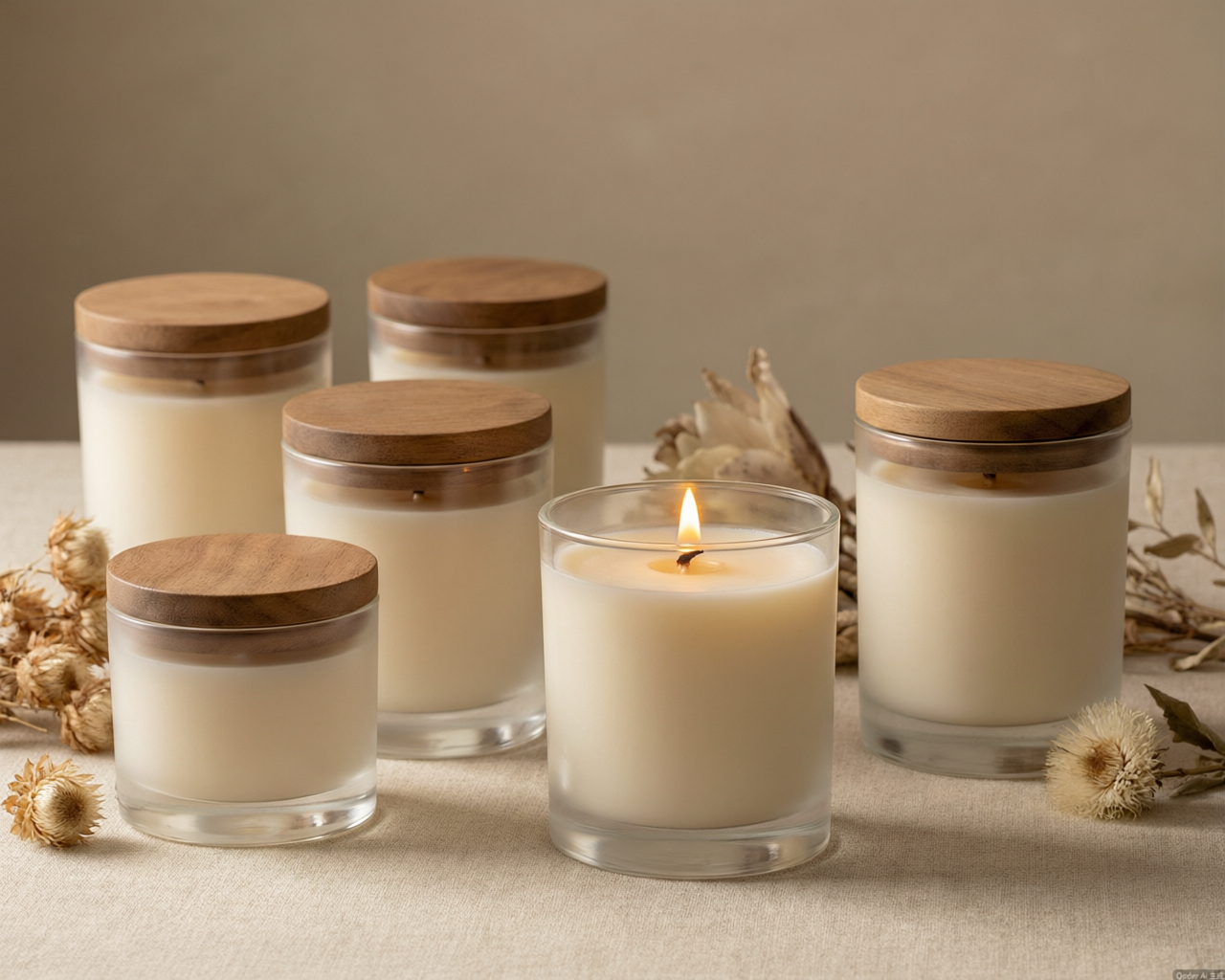
| Scented candles, stock vessel | 500–1,000 units per SKU | Wax and fragrance lot size |
| Scented candles, custom vessel | 3,000–10,000+ units | Glass mold and furnace minimums |
| Reed diffusers, stock bottle | 500–1,500 units per SKU | Bottle lot, fragrance volume |
| Reed diffusers, custom bottle | 2,000–5,000+ units | Mold, cap and collar tooling |
Two patterns are worth remembering: the vessel drives the number more than the fragrance does, and while a custom label on a stock jar rarely raises your MOQ, a custom jar raises it by an order of magnitude.
Sample vs pilot run vs bulk order
Treat these as three distinct stages:
Samples (1–5 units). You’re evaluating scent character, throw, wick behavior or packaging feel. Expect to pay shipping, sometimes a small fee credited to your first order. Good manufacturers move fast here — at Aromiso, standard samples ship in 7–10 days — because a queued sample converts nobody.
Pilot run (typically 500–1,000 units). A real production batch at reduced scale. Unit prices run higher than bulk, but you get sellable inventory, real product photos and market validation — and you catch packaging mistakes while the damage is small. Manufacturers with a structured OEM program usually have pilot-run pricing ready, so ask early. For a new brand, this is usually the right first order.
Bulk order (several thousand units and up). Full production at the best unit price — sensible only once product, packaging and channel are proven.
The classic mistake is skipping the pilot stage: ordering 5,000 units of a candle you’ve only smelled as a sample, then discovering it doesn’t perform in your market.
8 concrete ways to lower your MOQ
- Choose stock vessels. Standard jars, tins and diffuser bottles are your most effective MOQ lever. Custom shapes can wait until volume justifies them.
- Start from stock fragrances. A library of ready-made, IFRA-compliant scents skips compounding minimums entirely. Your signature blend can come later.
- Share components across SKUs. Same jar, same lid, same box — different labels. You hit the vessel MOQ once and split it across three products.
- Ask to split the MOQ across scents. Some manufacturers let one vessel MOQ cover two or three fragrances. Expect a small changeover surcharge — still far cheaper than three separate MOQs.
- Order in phases. Commit to an annual volume but take delivery in installments. The factory gets guaranteed volume; you keep cash flow and storage manageable.
- Plan seasonal orders early. Christmas candles ordered in July get priority and better component availability than the same order in October, when every vessel in the region is spoken for.
- Standardize packaging. Stock boxes and digital labeling avoid plate and die-cut minimums that quietly add thousands of units to your effective MOQ.
- Pick a manufacturer built for small batches. A factory whose published MOQ starts at 500 units — like Aromiso for candles and diffusers — has built its sourcing and lines around your situation instead of merely tolerating it.
How MOQ affects unit price
The mechanism is simple: fixed costs per run divided by units produced. Say a run carries roughly $600–900 of SKU-specific fixed costs — label plates, changeover, QC setup (illustrative; ask your supplier for real numbers). Over 500 units that’s about $1.20–1.80 per unit; over 3,000 it falls to roughly $0.20–0.30. Material buying power improves in steps too, though the saving from 3,000 to 10,000 units is proportionally smaller than the one from 500 to 3,000.
The practical takeaway: make your first order the smallest quantity that still yields a real, sellable batch — usually a pilot run. Pay the higher unit price deliberately; it’s the cost of learning before you scale.
Questions to ask a supplier about MOQ before ordering
- Is your MOQ per SKU or per order — and can I split it across fragrances or sizes?
- Which vessels and fragrances are stock, which are custom, and how does each affect the minimum?
- What do samples cost and how long do they take? (At Aromiso: 7–10 days.)
- Do you offer pilot runs, and how is pilot pricing structured against bulk?
- What are the lead times at 500, 1,000 and 5,000 units?
- Can I split delivery across two dates or destinations?
- Does the MOQ apply again on a repeat order of the same SKU?
- Where are the price-break steps, and what does each one save?
Get these answers in writing before you commit — it’s the difference between a supplier relationship and a surprise.
Conclusion
MOQ isn’t a fee or a favor — it’s manufacturing arithmetic. Understand it and you negotiate with it instead of against it: keep vessels standard, lean on stock fragrances, share components, and prove the product with a pilot run before scaling. Browse our product range, see how our OEM program structures small-batch production, or talk to our team about your first order.