Industry Verticals
Corporate Fragrance Gifting: Custom Candles & Diffusers for Brands
Every year, procurement teams spend weeks sourcing corporate gifts that recipients actually keep. Branded mugs end up in drawers. USB drives get lost. Pens run dry. The result is wasted budget and zero brand recall. Fragrance products solve this problem because they are consumable, sensory, and inherently premium. A custom corporate candle or branded diffuser gift sits on a desk or shelf for 40-60 hours of use, reinforcing brand association every time the recipient lights it or walks past it. The global corporate gifting market exceeded $312 billion in 2025, and fragrance categories are growing at roughly 9% annually as companies shift from generic swag to experiential gifts.
The challenge for B2B buyers is execution. Custom corporate fragrance orders involve fragrance selection, vessel customization, packaging design, compliance labeling, and tight delivery windows tied to events or fiscal year-end gifting cycles. A missed deadline means the gift arrives after the conference, after the holiday, after the moment has passed. This guide breaks down the entire sourcing process — from product selection through delivery — with specific cost ranges, timelines, and checklists so your team can execute a corporate candle gifts program without costly missteps.
Why Fragrance Outperforms Traditional Corporate Gifts
Corporate gifting budgets typically range from $15 to $150 per recipient depending on the tier (employee appreciation, client retention, VIP/executive). Within that range, fragrance products deliver measurable advantages over standard promotional items.
- Brand recall duration: A scented candle with 45+ hours burn time keeps your logo visible for weeks. A branded pen averages 3 weeks of use before disposal. Reed diffusers last 60-90 days in a home or office.
- Perceived value multiplier: A 200g soy candle in a custom-printed vessel with a magnetic-close gift box has a production cost of $4.50-$7.00 but a perceived retail value of $28-$45. That 5x-7x markup in perception is difficult to achieve with tech accessories or stationery.
- Universal appeal: Unlike alcohol (excluded for religious/health reasons) or food (allergy concerns), home fragrance is non-consumable and culturally neutral across most markets.
- Social sharing potential: Recipients photograph attractive candle and diffuser packaging for social media at a rate 3x higher than typical corporate merchandise, extending brand reach organically.
Product Selection: Matching Format to Occasion
Not every corporate gifting scenario calls for the same product format. The table below maps common use cases to optimal product choices with typical unit costs at MOQ 500.
| Use Case | Recommended Product | Unit Cost (FOB) | Lead Time | Best For |
|---|---|---|---|---|
| Conference event favor candle | 80g mini tin candle | $2.20-$3.80 | 25-30 days | 500-5,000 attendees, budget-conscious |
| Client appreciation gift | 200g glass jar candle + box | $5.00-$8.50 | 30-40 days | 100-1,000 key accounts |
| Executive VIP gift | Candle + diffuser gift set | $12.00-$22.00 | 40-50 days | 50-200 C-suite recipients |
| Employee onboarding kit | 120g candle + room spray | $6.50-$10.00 | 30-40 days | New hire welcome packages |
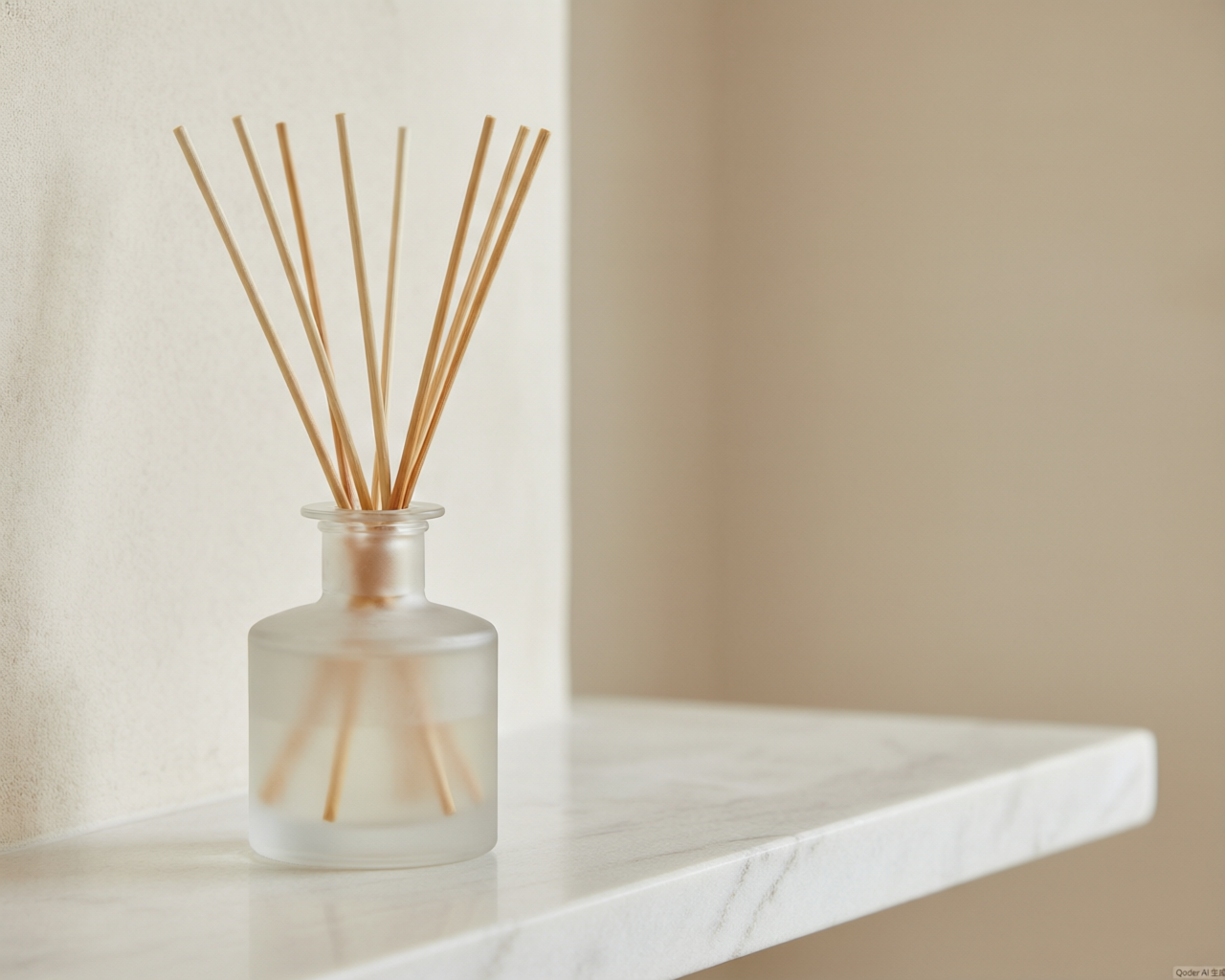
| Holiday season campaign | Branded reed diffuser 100ml | $3.80-$6.50 | 25-35 days | Broad distribution, 1,000+ units |
| Product launch event | Custom-shaped candle + sleeve | $4.00-$9.00 | 35-45 days | Brand-aligned novelty shapes |
When selecting formats, consider shipping logistics. Candles are heavier (glass vessels add 150-300g per unit), while reed diffusers contain liquid and may face restricted shipping classifications in some markets. For international distribution, diffusers under 100ml with low-flashpoint solvents may require DG (dangerous goods) documentation. Confirm shipping classification with your supplier before committing to volume.
Customization Options and Branding Specifications
A branded diffuser gift or corporate candle becomes a genuine brand asset only when customization is executed precisely. Here are the standard customization tiers offered by Chinese OEM manufacturers:
- Vessel decoration: Screen printing (1-3 colors, $0.15-$0.40/unit), ceramic decal (full-color, $0.50-$1.20/unit), or hot stamping in gold/silver foil ($0.20-$0.55/unit). For runs under 1,000 units, screen printing offers the best cost-to-quality ratio. Above 3,000 units, ceramic decal becomes economical and delivers a permanent, dishwasher-safe finish.
- Fragrance customization: Choose from 200+ stock scents at no extra charge, or commission a bespoke fragrance blend. Custom scent development typically costs $800-$2,500 for formulation and sampling, with a 4-6 week development timeline. Minimum order for custom scents is usually 1,000-3,000 units depending on the manufacturer.
- Packaging: Standard options include kraft sleeve ($0.30-$0.60), rigid magnetic box ($1.20-$3.50), or full printed carton ($0.80-$2.00). Add tissue paper, ribbon, or a printed insert card for $0.25-$0.75 per set.
- Wax and wick options: Soy wax, coconut-soy blend, or paraffin. Soy commands a premium positioning and costs $0.40-$0.80 more per unit than paraffin. Wooden wicks add a crackling sensory element at $0.30-$0.60 additional cost.
Request physical samples before approving any customization. A reputable OEM supplier will provide 2-3 sample rounds included in the project fee. Review samples for print registration accuracy, scent throw strength (cold and hot), and packaging structural integrity under simulated shipping conditions.
Budgeting: True Landed Cost Breakdown
Procurement teams often budget on FOB unit price alone and encounter 25-40% cost overruns at delivery. Here is a realistic landed cost model for a 1,000-unit order of 200g branded candles with custom boxes, shipped to the US West Coast:
| Cost Component | Per-Unit Amount | Notes |
|---|---|---|
| FOB product cost | $6.50 | Includes vessel, wax, fragrance, wick |
| Custom packaging | $1.80 | Rigid box with magnetic closure |
| Freight (sea, LCL) | $1.10 | Based on 0.8 CBM, $1,350/CBM rate |
| Import duty (HTS 3406) | $0.52 | 8% of customs value |
| Customs brokerage | $0.25 | Flat fee amortized |
| Inland delivery | $0.35 | Port to warehouse |
| Inspection/QC | $0.18 | Third-party pre-shipment inspection |
| Total landed cost | $10.70 |
For EU destinations, add VAT (19-27% depending on member state) and ensure CLP labeling compliance, which adds $0.10-$0.30 per unit for compliant label printing. For orders under 500 units, air freight may be more economical than sea despite higher per-kg rates, reducing total transit time from 35-45 days to 7-12 days.
Timeline Planning: Working Backward from Your Event
The most common failure in corporate fragrance gifting is timeline compression. A custom corporate fragrance order requires multiple sequential steps, and rushing any of them introduces quality risk.
- Week 1-2: Brief alignment and supplier selection. Issue RFQs to 3-5 manufacturers. Request product catalogs, compliance certificates (IFRA, MSDS, CPSIA for US, CLP for EU), and reference client lists.
- Week 3-4: Sampling phase. Approve vessel, fragrance, and packaging samples. Allow 10-14 days for sample production and international courier delivery.
- Week 5: Purchase order confirmation and deposit payment (typically 30-50% upfront).
- Week 6-10: Mass production. Standard production time is 25-35 days for orders up to 5,000 units. Larger orders (10,000+) may require 40-50 days.
- Week 11: Pre-shipment inspection (1-2 days on-site) and final payment.
- Week 12-16: Ocean freight transit (25-35 days to US/EU) or air freight (5-8 days).
- Week 17: Customs clearance and inland delivery (3-7 days).
Total timeline from brief to warehouse: 14-18 weeks for sea freight, 10-12 weeks for air. If your event is in Q4 (October-December holiday gifting season), place orders by June at the latest. Chinese factories experience peak capacity pressure from August through October, and lead times extend by 2-3 weeks during this window.
Compliance and Labeling Requirements by Market
Corporate gifts are not exempt from consumer product regulations, even when distributed free of charge. Non-compliant products can be seized at customs or trigger recalls.
- United States: Candles must comply with ASTM F2417 (fire safety) and CPSIA if marketed to or accessible by children. California Prop 65 warnings are required if any fragrance component appears on the Prop 65 list. Label must include net weight, manufacturer name/address, and burn instructions.
- European Union: CLP Regulation (EC 1272/2008) requires hazard pictograms, signal words, and precautionary statements on any product containing fragrance allergens above threshold concentrations (0.01% for rinse-off, 0.001% for leave-on equivalents). REACH registration applies to imported chemical substances.
- United Kingdom: UK CLP mirrors EU requirements but requires a UK-based responsible person on the label post-Brexit.
- Australia/New Zealand: NICNAS (now AICIS) notification may be required for new fragrance chemicals. Mandatory safety standard for candles applies.
Request a full IFRA compliance certificate and MSDS/SDS for every fragrance used. Confirm that your supplier’s labeling template matches destination-market requirements before production begins, not after goods ship.
Supplier Evaluation Checklist for Corporate Buyers
Selecting the right OEM partner determines whether your corporate candle gifts arrive on time, on budget, and on brand. Use this checklist when evaluating Chinese fragrance manufacturers:
- Production capacity: Confirm monthly output capacity (units/month) and current utilization. A factory running at 90%+ capacity during your order window is a scheduling risk.
- Certifications: ISO 9001 (quality management), ISO 14001 (environmental), BSCI or Sedex (social compliance). These are baseline for any supplier handling orders above $20,000.
- Fragrance library and R&D: A manufacturer with in-house perfumers can develop custom corporate fragrance blends faster and with tighter quality control than one outsourcing scent formulation.
- Sample turnaround: Expect 7-10 days for standard samples, 14-21 days for fully custom designs. Suppliers who quote 3-day sampling are likely cutting corners on curing or testing.
- QC infrastructure: Ask for their AQL inspection protocol (standard is AQL 2.5 for major defects, 4.0 for minor). Confirm whether they accept third-party inspection (SGS, Bureau Veritas, Intertek).
- Export experience: Request shipment records for your destination country. Experienced exporters handle documentation (commercial invoice, packing list, certificate of origin, fumigation certificate for wooden packaging) without delays.
- Communication: Dedicated English-speaking account manager, response time under 12 hours, and willingness to schedule video factory tours.
Maximizing Impact: Packaging and Presentation Strategy
The unboxing moment is where a corporate gift either reinforces brand prestige or undermines it. For executive-tier gifts especially, packaging accounts for 30-50% of the perceived value.
- Tiered approach: Match packaging investment to recipient tier. A $3.50 rigid box with soft-touch lamination and foil-stamped logo suits VIP clients. A $0.60 kraft sleeve with single-color print works for broad employee distributions.
- Insert strategy: Include a branded card (350gsm, matte finish) with a personal message from leadership, QR code linking to a curated playlist or brand story, and care instructions. Cost: $0.15-$0.40 per card.
- Gift set configuration: Pair a 200g candle with a 50ml reed diffuser and a box of 10 wax melts in a compartmentalized tray. Sets increase perceived value by 40-60% over single items at only 25-35% additional cost.
- Seasonal theming: Holiday collections (cinnamon-clove, pine-forest, vanilla-chai) outperform generic scents 3:1 for Q4 corporate gifting. Lock seasonal fragrances by July to secure raw material availability.
For event favor candle applications at conferences or product launches, consider adding a functional element: a seed-embedded box lid the recipient can plant, or a reusable ceramic vessel that doubles as a desk organizer after the candle is consumed. These touches extend brand interaction beyond the product lifecycle.
Next Steps
If you are planning a corporate fragrance gifting program for an upcoming event, holiday cycle, or client retention campaign, the most efficient path forward is a structured consultation with an OEM manufacturer who handles the full scope — fragrance development, vessel customization, packaging, compliance labeling, and export logistics.
Review the product catalog to identify formats that match your recipient profile and budget tier. Then explore the OEM program to understand customization capabilities, MOQ structures, and sampling workflows. When you have a preliminary brief ready (product format, quantity, target delivery date, destination market), request a quote with your specifications attached. A detailed brief accelerates the quotation process from 5 business days to 48 hours and ensures the pricing you receive reflects your actual requirements rather than generic catalog rates.
For orders exceeding 3,000 units, request a dedicated project timeline with milestone checkpoints. For orders under 500 units, ask about stock vessel options with custom labeling to reduce lead time by 2-3 weeks. Either way, start the conversation at least 16 weeks before your target delivery date to preserve quality and avoid peak-season surcharges.