Buying Guides
Luxury Candle Specifications: What Defines a Premium Product
Este artículo aún no está disponible en español. Lo estás viendo en inglés.

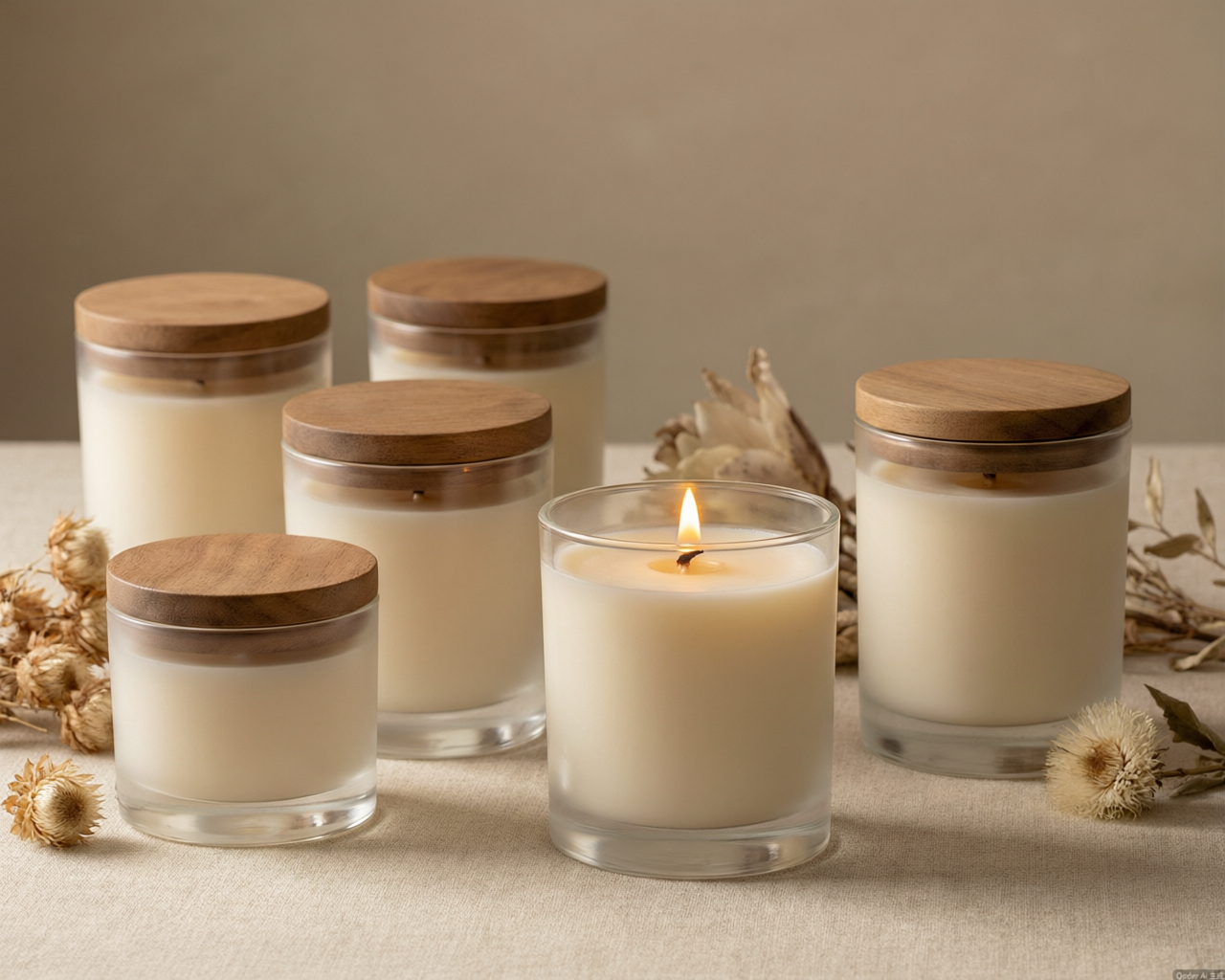
“Luxury” in candles is not a vague marketing term — it is a set of measurable specifications that justify a price point of $45-$120+ at retail. For B2B buyers developing a premium line, understanding these specifications allows you to write precise production briefs and evaluate factory capabilities objectively.
Wax Formulation: The Foundation
Luxury candles rarely use single-origin wax. Premium formulations typically employ proprietary blends:
- Coconut-soy blend (70/30 or 60/40): Delivers a creamy, opaque finish with slow, even burn. Melt point of 47-52 C.
- Coconut-apricot-soy blend: Adds apricot kernel wax for a smoother surface and slightly higher melt point (50-54 C).
- Vegetable wax blend with microcrystalline additive: Improves glass adhesion and eliminates wet spots while maintaining a “100% plant-based” claim.
Specification to request: Wax blend composition sheet, DSC (Differential Scanning Calorimetry) melt curve, and oil-binding capacity percentage. A luxury-grade blend should hold 10-12% fragrance oil without seepage.
Cost implication: Premium wax blends run $4.50-$8.00 per kg versus $1.50-$2.50 for standard paraffin or basic soy. For a 300g candle, this adds approximately $1.00-$2.00 to unit cost.
Fragrance: Complexity and Compliance
Luxury candle fragrances differ from standard offerings in three ways:
-
Note structure: Premium fragrances use 3-tier pyramids (top, heart, base) with 15-30 individual components versus 5-10 for basic scents. This creates evolving scent profiles that change over the 40-60 hour burn life.
-
Raw material quality: Luxury formulations incorporate natural essential oils (typically 10-30% of the blend) alongside synthetics. Common premium naturals include French lavender absolute ($180-$250/kg), Indian sandalwood oil ($1,500-$2,500/kg), and Turkish rose otto ($8,000-$12,000/kg).
-
Concentration and load: Luxury candles typically run 8-12% fragrance load in coconut or coconut-blend wax, delivering room-filling throw without the harshness of overloaded paraffin.
Specification to request: Full IFRA compliance certificate, allergen declaration (EU CLP 26 allergens), fragrance pyramid documentation, and recommended maximum usage rate. Request a 30-day stability test report showing no discoloration or scent degradation.
Cost implication: Premium fragrance oils cost $25-$80 per kg versus $8-$15 for standard catalog scents. At 10% load in a 300g candle, fragrance cost ranges from $0.75 to $2.40 per unit.
Wick Engineering
Luxury candles specify wicks for performance and aesthetics:
- Wooden wicks: 12-16mm width, FSC-certified cherry or maple. Produce a soft crackling sound (measured at 25-35 dB) and a wide, even melt pool. Burn rate: 4-6g per hour.
- Premium cotton wicks: Flat-braid or cored (zinc-free paper core), sized to achieve a melt pool reaching 85-95% of vessel diameter within 2-3 hours.
- Multi-wick configurations: 2-3 wicks in vessels above 8cm diameter, spaced at equal intervals with minimum 3cm from vessel wall.
Specification to request: Wick tab dimensions, sustainment tab material (sustainer tabs should be lead-free, nickel-plated steel), flame height test data (maximum 4cm per ASTM F2417), and soot rating (scale of 1-10, luxury standard is 8+).
Burn Performance Standards
A luxury candle must meet these burn criteria:
- Total burn time: Minimum 50 hours for a 250g candle; 60+ hours for 300g
- Melt pool: Full edge-to-edge melt within 2.5 hours of first burn (prevents tunneling)
- Flame stability: No flickering, smoking, or flame height variation greater than 5mm in still air
- Residual wax: Less than 5% wax remaining on vessel walls at end of life
- Cold throw: Detectable at 1 meter distance in a 20-square-meter room, unlit
- Hot throw: Fills a 30-square-meter room within 30 minutes of lighting
Specification to request: Third-party or in-house burn test report covering full lifecycle (not just first 4 hours). Minimum 5-unit sample per batch tested to completion.
Vessel and Packaging Standards
Luxury specifications extend to every touchpoint:
Vessel:
- Glass weight: 350g+ for a 300ml jar (heavy base conveys quality)
- Wall thickness: 5-7mm minimum
- Finish: Hand-applied gradient, reactive glaze (ceramic), or electroplated metallic
- Tolerance: Plus or minus 1mm on diameter, plus or minus 2mm on height
Packaging:
- Rigid box: 1,200-1,500gsm greyboard with 157gsm art paper wrap
- Finish: Soft-touch lamination, spot UV, foil stamping (gold, silver, or holographic)
- Interior: EVA foam or molded pulp insert with satin or velvet lining
- Unboxing experience: Magnetic closure or ribbon pull-tab
Cost implication: Luxury packaging adds $2.00-$5.00 per unit versus $0.30-$0.80 for a standard folding carton.
Quality Control for Luxury Production
Specify these QC checkpoints in your production agreement:
- Incoming material inspection: Wax melt point verification, fragrance GC-MS fingerprint matching, wick burn-rate pre-test
- In-line inspection: Pour temperature (plus or minus 2 C tolerance), fragrance addition weight (plus or minus 0.1g), wick centering (plus or minus 1mm)
- Post-cure inspection (7-14 days): Surface finish (no frosting, sinkholes, or wet spots), cold throw intensity panel test
- Pre-shipment AQL inspection: AQL 2.5 for major defects, AQL 4.0 for minor defects per ISO 2859-1
- Burn test sampling: 3% of each batch (minimum 10 units) burned to completion
The Luxury Price Build-Up
For a 300g luxury candle at 1,000-unit quantity, typical FOB cost structure:
| Component | Cost Range |
|---|---|
| Premium wax blend (300g) | $1.50-$2.50 |
| Premium fragrance (10% load) | $1.00-$2.50 |
| Wooden wick + tab | $0.25-$0.45 |
| Heavy glass or ceramic vessel | $1.50-$4.00 |
| Lid (walnut or custom metal) | $0.80-$2.00 |
| Luxury packaging | $2.50-$5.00 |
| Labor, QC, overhead | $1.50-$3.00 |
| Total FOB | $9.05-$19.45 |
At a 4x-6x retail markup, this supports a $45-$120 retail price point.
Final Note
Luxury is defined by consistency as much as by material quality. A $60 candle that performs identically across every unit in a 5,000-piece production run is more valuable to your brand than a spectacular prototype that varies in production. When selecting a manufacturing partner for luxury candles, prioritize factories that document every specification, run statistical process control, and provide batch traceability from raw material lot to finished unit.