Product Knowledge
Fragrance Oils for Soap Making: Stability, Flash Point, and Usage Rates
Dieser Artikel ist noch nicht auf Deutsch verfügbar. Sie lesen die englische Version.
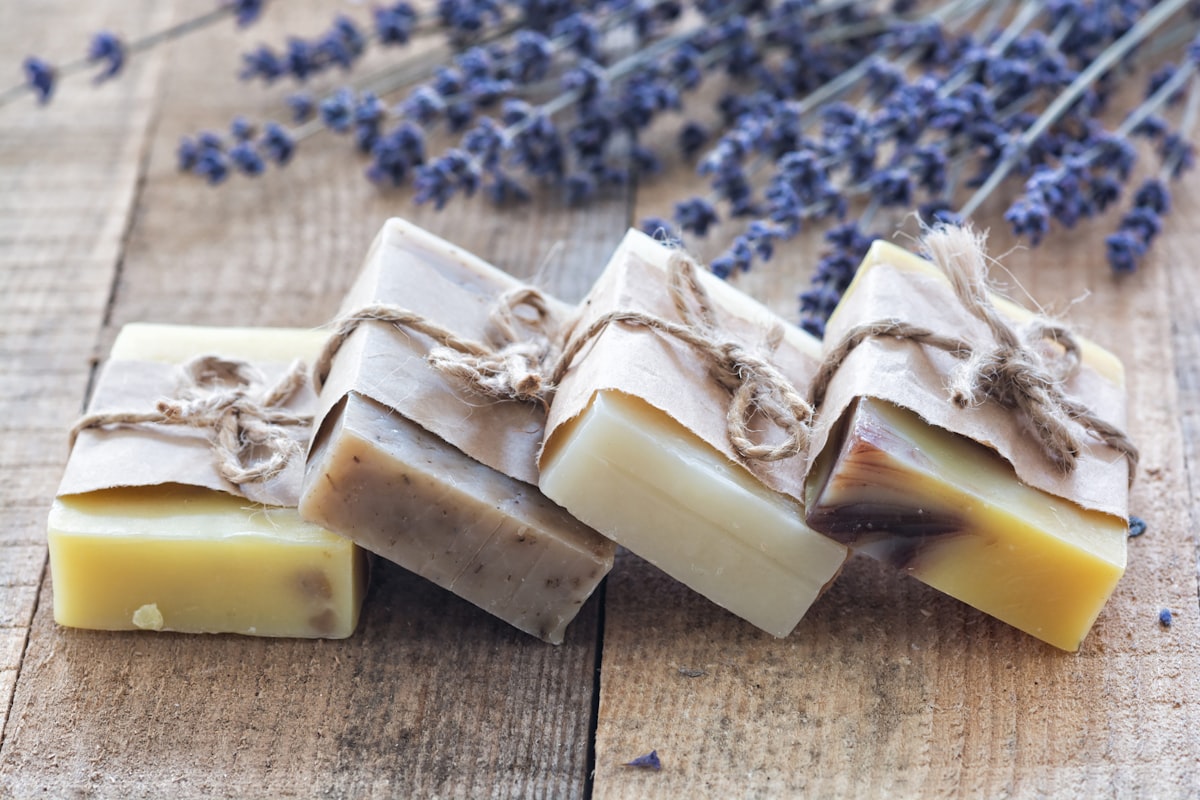
Fragrance oils behave very differently in soap than they do in alcohol-based perfumes or emulsion creams. The high pH of cold-process soap, the heat of saponification, and the long cure time all stress fragrance materials in ways that surprise buyers new to the category. This article covers the technical specifications that determine whether a fragrance oil will perform in soap, and the typical usage rates and defects that production teams need to manage.
Cold Process vs Melt and Pour: Different Demands
The two dominant soap production methods impose different requirements on fragrance:
Cold process (CP) soap is made by saponifying oils with sodium hydroxide at 35-50C, then curing for 4-6 weeks. The fragrance must survive:
- Initial pH of 10-14 during saponification, settling to 9-10 after cure
- Exothermic reaction reaching 50-80C in molds
- 4-6 weeks of alkaline curing
- Long-term oxidation exposure
Melt and pour (MP) soap uses a pre-saponified base melted at 60-75C, poured, and cooled. The fragrance faces:
- Brief heat exposure (60-75C)
- Near-neutral to mildly alkaline pH (8-9)
- No saponification stress
- Faster time to market (days, not weeks)
A fragrance that performs well in MP may fail in CP, and vice versa. Buyers should always request CP and MP test data separately.
Usage Rates
Typical fragrance usage rates in soap:
- Cold process soap: 3-5% of oil weight (commonly 3-4% for IFRA-compliant formulas)
- Melt and pour soap: 1-3% of base weight
- Hot process soap: 2-4%
- Liquid soap: 0.5-2%
The 3-5% range for CP soap is the industry standard. Below 3%, scent may be too faint after cure. Above 5%, risks include acceleration, seizing, sweating, and IFRA non-compliance for skin-contact categories.
IFRA Category 9 (rinse-off, including soap) typically allows higher fragrance levels than leave-on categories, but specific materials may still cap the usable rate. A fragrance with 2% of a material restricted to 0.5% in Category 9 limits the soap to 25% fragrance, well above typical usage; a material restricted to 0.05% would cap soap usage at 2.5%, which is binding.
Flash Point and Safety
Flash point matters for both production safety and shipping classification:
- Most fragrance oils have flash points between 60C and 100C.
- Oils with flash points below 60C require additional handling controls and may be classified as Class 3 flammable liquids (UN1263) for shipping.
- CP soap makers should add fragrance below the oil’s flash point, typically at trace (40-50C).
- MP soap makers should add fragrance after the base has cooled to 60-65C to minimize evaporation.
Buyers should request flash point data on the SDS for every fragrance oil, and confirm that the supplier’s shipping classification matches their own logistics requirements.
Common Defects and Their Causes
Fragrance-soap interactions produce several well-known defects:
Acceleration. The soap batter thickens rapidly after fragrance addition, making pouring and swirling difficult. Caused by certain florals (jasmine, lilac), spices, and high-vanillin formulas. Mitigation: add fragrance at cooler temperatures, use slower-moving recipes, or select acceleration-tested fragrances.
Ricing. The batter forms grainy lumps instead of remaining smooth. Often caused by fragrance materials that react with lye or with specific oils. Mitigation: stick-blend through ricing if mild, or reformulate.
Seizing. The batter solidifies almost instantly, sometimes within seconds. The most severe form of acceleration; usually unrecoverable. Common with some cinnamon, clove, and heavy floral fragrances.
Discoloration. Vanillin and related materials turn soap tan, brown, or yellow over weeks of cure. Mitigation: use vanillin-free fragrances, add a vanillin stabilizer (sodium thiosulfate or proprietary stabilizers), or accept the color as part of the design.
Sweating. Glycerin-rich MP soap attracts moisture, sometimes worsened by certain fragrance components. Mitigation: control humidity, wrap finished bars promptly.
Fading. Top notes (citrus, light fruits) evaporate or degrade during cure. Mitigation: use anchored citrus bases, increase usage rate within IFRA limits, or fold fragrance in at a cooler stage.
Specification Checklist for Soap Fragrance
A complete soap-fragrance specification should include:
- CP and MP compatibility test results, including acceleration, ricing, and discoloration observations
- Flash point (closed cup, per ASTM D93 or equivalent)
- IFRA Category 9 certificate with maximum usage percentage
- Vanillin content (so makers can plan stabilizer use)
- Allergen declaration per EU 1223/2009 and amendments
- SDS with full handling and shipping classification
- Cure stability data, ideally 6-week and 12-week scent retention panels
- Color stability in both white and natural soap bases
Reputable soap-fragrance suppliers publish CP test notes for each oil, including acceleration rating (none, mild, moderate, severe), discoloration outcome, and recommended usage rate.
Production Planning
For private-label soap buyers:
- Order fragrance at 1.05-1.10x theoretical usage to allow for production loss.
- Store fragrance oils at 15-25C, away from light, with a typical shelf life of 12-24 months.
- Run a 5-10 kg pilot batch before scaling, because fragrance behavior can shift with batch size and equipment.
- Document cure-room conditions (temperature, humidity), because they affect both saponification and scent retention.
Briefing a Manufacturer
A practical soap-fragrance brief should state:
- Production method (CP, MP, hot process, liquid)
- Target usage rate (for example, 3.5% of oil weight)
- Scent family and reference fragrances
- Color requirements (white base, natural base, swirled)
- Cure time and target shelf life
- Regulatory markets (EU, US, China, GCC)
At Aromiso, every soap-grade fragrance oil is tested in both CP and MP at 3%, 4%, and 5% usage rates, with documented acceleration, ricing, and discoloration notes, so that buyers can select scents that match their production method without trial-and-error batches.