Cost & Pricing
What Determines Private Label Candle Price? A Cost Factor Breakdown
Este artículo aún no está disponible en español. Lo estás viendo en inglés.
When you request a quote for private label candles, the number that comes back can vary dramatically between suppliers. A 200g scented candle in a glass jar might be quoted at $2.80 by one factory and $6.50 by another. Understanding what drives these differences helps you evaluate quotes accurately and budget with confidence.
This guide breaks down the major cost factors that determine private label candle pricing, with typical market ranges to help you benchmark supplier quotes.
Wax Type: The Foundation Cost
Wax is the single largest material cost in candle production, and your choice here sets the baseline price.
Paraffin wax remains the most economical option, with typical market pricing in the range of $1.50-$3.00 per kg for refined grades. It offers excellent scent throw and consistent burn performance, making it popular for mass-market candles.
Soy wax commands a premium, typically ranging from $3.00-$6.00 per kg depending on origin and refinement level. US-grown, non-GMO soy sits at the higher end. Soy appeals to eco-conscious consumers and burns cleaner, but the raw material cost is 50-100% higher than paraffin.
Coconut wax blends represent the premium tier at $5.00-$9.00 per kg. These blends deliver superior scent throw and a smooth, creamy appearance that justifies luxury retail positioning.
Beeswax sits at the top of the cost spectrum, often $12.00-$25.00 per kg for pure grades. Most commercial candles use beeswax as a blend component rather than the primary wax.
For a standard 200g candle, the wax cost difference between paraffin and a coconut-soy blend can be $0.40-$1.20 per unit.
Fragrance Load and Quality
Fragrance oil typically represents 15-30% of total candle cost, yet it has an outsized impact on product performance.
Standard fragrance loads range from 6-10% of wax weight. A 200g candle at 8% load uses approximately 16g of fragrance oil. At typical market rates of $15-$45 per kg for quality fragrance oils, that translates to $0.24-$0.72 per candle in fragrance cost alone.
Premium or niche fragrance compositions from European houses can reach $60-$120 per kg, pushing per-candle fragrance cost above $1.00.
The fragrance load percentage also matters. Increasing from 6% to 10% load improves scent throw but adds 40-60% more fragrance cost per unit.
Vessel and Container
The container is often the second-largest cost component after wax and fragrance combined.
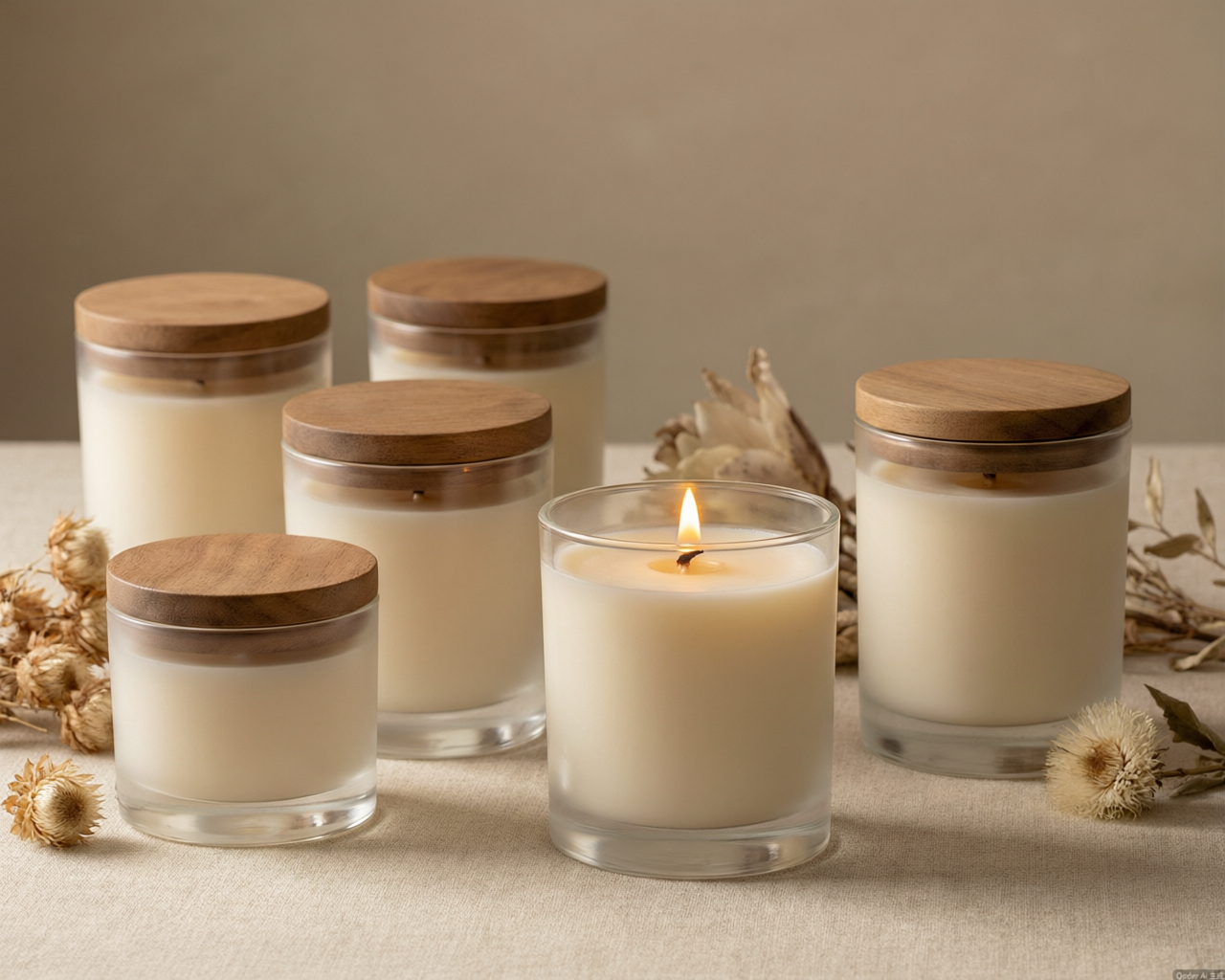
Standard glass jars (200-300ml) typically range from $0.30-$0.80 per unit at volume. Simple straight-sided jars in clear or amber glass fall at the lower end.
Premium vessels with custom shapes, frosted finishes, or colored glass run $0.80-$2.50 per unit. Hand-blown or recycled glass with unique textures can exceed $3.00.
Metal tins offer a budget alternative at $0.20-$0.60 per unit, popular for travel-size candles.
Ceramic containers start around $1.00 and can reach $4.00+ for handcrafted pieces.
Lids add $0.10-$0.50 per unit depending on material (bamboo, metal, or glass).
Wick Selection
Wick cost per unit seems small ($0.03-$0.15) but multiplies across large orders. Cotton wicks with sustain tabs are the most economical. Wood wicks, which create a crackling sound and wider melt pool, cost 3-5x more at $0.10-$0.40 per unit. Multi-wick configurations double or triple this cost.
Labor and Production Complexity
Production labor varies with candle complexity. A simple single-pour container candle requires less labor than a layered, multi-pour design with embedded elements. Typical production labor adds $0.20-$0.60 per unit for standard candles. Complex designs with multiple pours, decorative tops, or hand-finishing can add $0.50-$1.50.
Packaging
Individual packaging ranges from $0.10-$0.30 for a basic kraft box to $0.80-$2.00 for rigid boxes with foam inserts, magnetic closures, or custom printing. Shrink wrap is the most economical at $0.03-$0.08 per unit.
Order Volume
Volume dramatically affects per-unit pricing. Most factories apply tiered pricing:
- 500-1,000 units: Base pricing (highest per-unit cost)
- 1,000-3,000 units: 5-15% reduction
- 3,000-10,000 units: 15-25% reduction
- 10,000+ units: 25-35% reduction from base
This reflects fixed costs (setup, mold preparation, quality checks) distributed across more units and better material pricing at volume.
Compliance and Testing
Regulatory testing adds fixed costs that amortize across your order. CLP labeling for Europe, ASTM testing for the US, and safety assessments typically add $200-$800 per SKU as a one-time cost. Spread across 5,000 units, this adds only $0.04-$0.16 per candle.
Putting It Together: A Sample Cost Structure
For a mid-range 200g soy candle in a glass jar with 8% fragrance load at 3,000-unit volume, typical market pricing breaks down approximately as:
- Wax: $0.80-$1.20
- Fragrance: $0.35-$0.60
- Glass jar with lid: $0.50-$0.90
- Wick and assembly: $0.15-$0.30
- Packaging: $0.20-$0.50
- Labor and overhead: $0.30-$0.60
Total FOB price range: $2.30-$4.10 per unit
Getting Accurate Quotes
When requesting quotes, specify wax type, fragrance load percentage, vessel dimensions, wick preference, packaging requirements, and target volume. The more precise your brief, the more comparable your quotes will be across suppliers.
Understanding these cost drivers transforms pricing from an opaque number into a transparent equation you can optimize for your brand positioning and margin targets.