Buying Guides
Essential Oil Bottle Selection: Glass Type, Dropper, and Closure
Este artículo aún no está disponible en español. Lo estás viendo en inglés.

The bottle is part of the product. Essential oils degrade under UV light, attack certain plastics, and evaporate through poor seals, so packaging decisions belong in the procurement spec, not the marketing deck. Here is how to specify bottles the way a contract manufacturer does.
Glass Type: Amber, Cobalt, or Clear
Type III soda-lime glass is the standard for essential oils. Type I borosilicate is reserved for high-purity laboratory and pharmaceutical work and rarely justifies its 2-3x cost for retail oils.
Color matters more than glass chemistry:
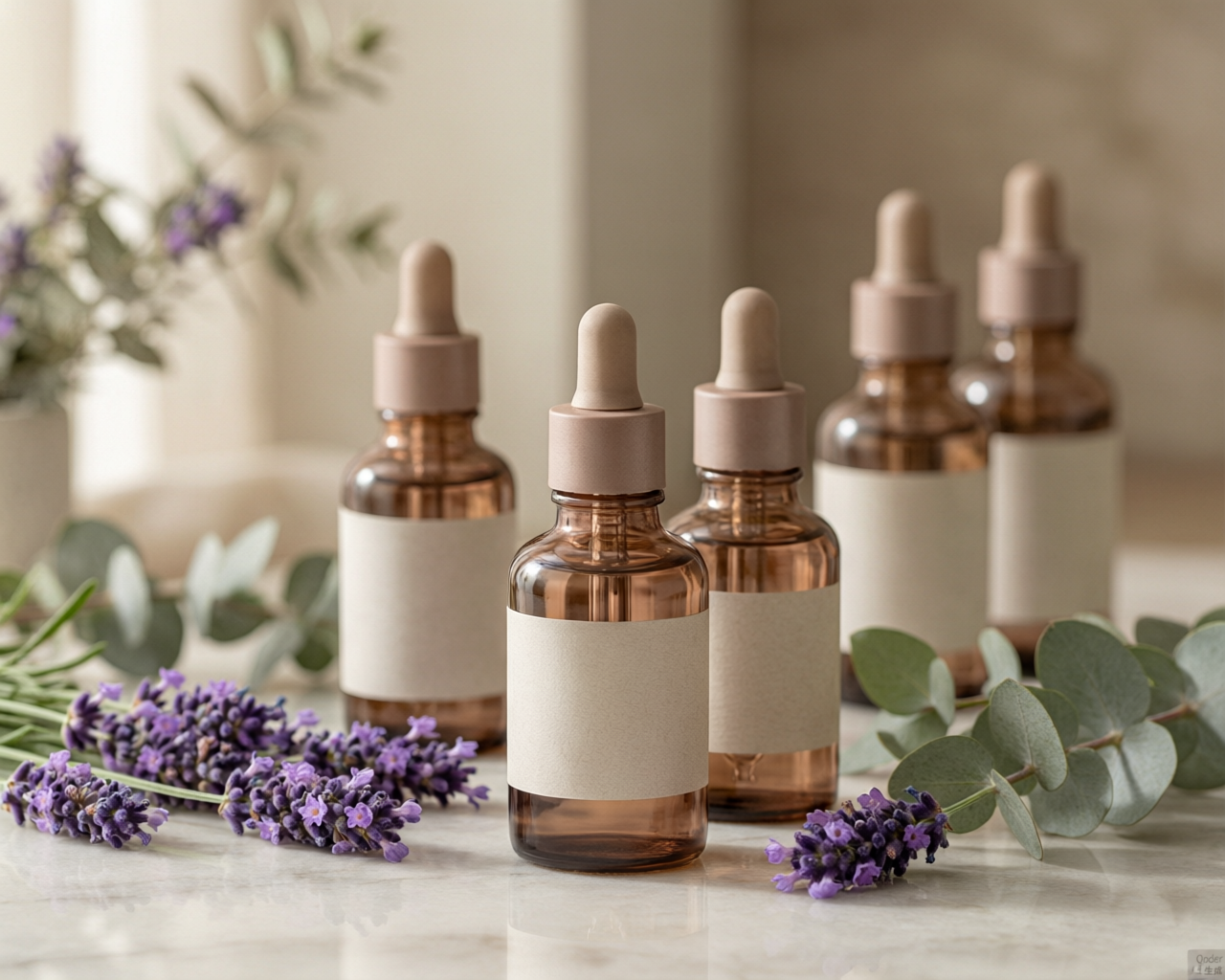
- Amber glass blocks roughly 90% of UV below 450 nm and is the default for citrus, conifer, and oxidizable oils.
- Cobalt blue blocks less UV than amber but photographs better and is common in premium skincare-adjacent lines.
- Green (UVAG) sits between amber and cobalt on protection and is mostly a brand choice.
- Clear glass is acceptable only for stable oils (sandalwood, cedarwood) inside an opaque secondary carton.
For oils high in limonene, pinene, or linalool, specify amber as the default. UV-driven oxidation produces peroxides that turn a skin-safe oil into a sensitization risk within 6-12 months on a lit shelf.
Bottle Sizes and Neck Finishes
Retail essential oil bottles cluster around a few sizes:
- 5 ml and 10 ml: the standard retail SKUs, DIN 18 neck finish
- 15 ml and 30 ml: common for blends and roll-on refills, DIN 18 or GL 18
- 50 ml and 100 ml: professional and aromatherapist sizes, GL 22 or GL 25
- 250 ml to 1 liter: bulk retail and spa back-bar, GL 28 to GL 32
The neck finish (DIN 18, GL 18, etc.) determines which droppers, orifice reducers, and caps fit. Lock the neck finish before designing labels and cartons, because tolerance differences between DIN and GL standards affect cap height and shoulder clearance.
Dropper vs Orifice Reducer
Two dispensing systems dominate:
Euro dropper (pipette cap). A glass pipette with a rubber bulb and a tamper-evident cap. Best for 5-30 ml bottles where the user doses by drop. Specify a bulb volume of 0.7-1.0 ml and a pipette tip diameter that delivers 20-25 drops per ml for low-viscosity oils. Nitrile bulbs outlast natural rubber when in contact with citrus and conifer oils.
Orifice reducer. A plastic insert pressed into the neck, paired with a screw cap. Better for high-volume use, travel kits, and oils that degrade rubber. Reducers deliver a more consistent drop size (typically 0.04-0.05 ml per drop) and resist clogging from resinous oils like benzoin or myrrh.
For roll-ons, the ball assembly replaces both. Stainless steel balls (10 mm for 10 ml bottles) are the default; plastic balls swell with neat essential oils and should be avoided.
Closures and Torque
Caps are typically polypropylene (PP) or urea. PP is the workhorse: chemically resistant, recyclable, and inexpensive. Urea gives a heavier, premium feel but is brittle in cold shipping.
Specify closure torque at fill. For a DIN 18 cap, application torque of 1.0-1.4 N-m and removal torque above 0.6 N-m is the typical band. Too low and the bottle leaks in air freight; too high and consumers strip the liner. Ask your filler for a torque test report on every lot.
Child-Resistant and Tamper-Evident Options
In the US, the Poison Prevention Packaging Act requires child-resistant closures for many essential oils sold retail, particularly those containing methyl salicylate (wintergreen) above threshold levels and certain camphor-rich oils. CRC caps meet CPSC protocol 16 CFR 1700.20 and add roughly USD 0.05-0.15 per unit.
Tamper-evident features (breakaway ring, shrink band, induction seal under the cap) are not legally required everywhere but are increasingly expected by Amazon, Walmart, and EU distributors. An induction-sealed aluminum foil liner under a standard cap costs USD 0.02-0.05 per unit and prevents both tampering and slow evaporation losses.
Secondary Packaging
A 10 ml bottle in a rigid setup box with an EVA foam insert is the standard premium presentation. Cost benchmarks:
- Folding carton (350 gsm SBS, 4-color print): USD 0.10-0.30
- Rigid setup box with foam insert: USD 0.60-1.50
- Kraft sleeve with window: USD 0.15-0.40
Cartons also carry the regulatory load: ingredient list, warnings, batch code, and country of origin often live on the box, not the bottle.
The Bottle Spec Sheet
A complete bottle specification should list:
- Glass type and color (for example, Type III amber)
- Nominal and overflow capacity (10 ml nominal, 12.5 ml overflow)
- Neck finish (DIN 18)
- Dispensing system (Euro dropper, nitrile bulb, 0.8 ml volume)
- Cap material, color, and torque range
- Liner and tamper-evidence (induction seal, breakaway ring)
- Child-resistance certification, if required
- Drop-test and leak-test acceptance criteria
Lock these eight lines before requesting fill quotes and you will compare suppliers on price and lead time instead of re-litigating packaging in every negotiation.