Cost & Pricing
Candle Production Cost per Unit: Materials, Labor, and Overhead
Este artículo aún no está disponible en español. Lo estás viendo en inglés.
Understanding the true cost to produce a single candle is essential for any brand owner or importer negotiating with manufacturers. Whether you are launching a private label line or scaling an existing collection, knowing how each cost component contributes to the final unit price gives you leverage in supplier discussions and protects your margins.
This guide breaks down the per-unit production cost of a standard container candle (200g to 300g fill weight) using typical market ranges observed across Chinese contract manufacturers in 2024-2025.
Raw Material Costs
Raw materials typically represent 45% to 60% of total unit cost for a mid-range scented candle.
Wax. Soy wax costs range from $1.80 to $3.20 per kilogram depending on origin and certification status. Paraffin wax is cheaper, typically $0.90 to $1.60 per kilogram, while coconut-soy blends fall between $2.50 and $4.00 per kilogram. For a 250g candle, wax alone accounts for $0.45 to $1.00 of unit cost.
Fragrance oil. This is often the most variable input. Standard fragrance oils run $8 to $18 per kilogram, while premium or niche accords can reach $25 to $60 per kilogram. At a 10% fragrance load in a 250g candle, you use roughly 25g of oil, translating to $0.20 to $1.50 per unit depending on quality tier.
Wick and wick assembly. Cotton wicks cost $0.02 to $0.06 each. Wood wicks range from $0.08 to $0.20 each. Including the metal sustainer tab and adhesive, budget $0.05 to $0.25 per candle.
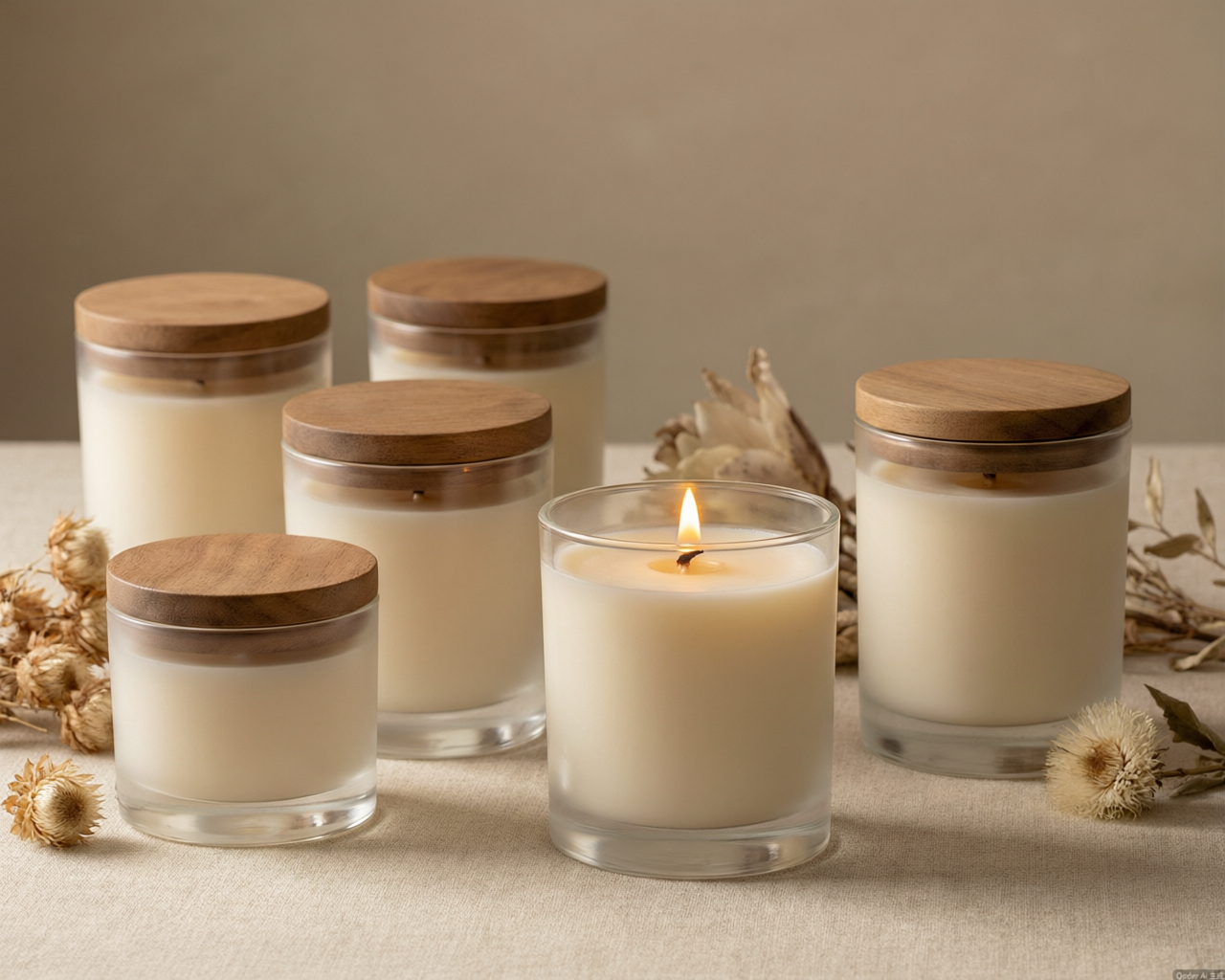
Vessel. Glass jars represent a significant cost driver. A standard 250ml amber or clear glass jar costs $0.30 to $0.70. Custom shapes, colored glass, or heavy-walled luxury vessels can push this to $1.00 to $2.50 per unit. Tin containers are slightly cheaper at $0.25 to $0.60.
Lid. Bamboo lids add $0.20 to $0.50. Metal lids range from $0.15 to $0.40. Cork or wooden lids fall in the $0.25 to $0.60 range.
Packaging Costs
Individual packaging adds $0.15 to $1.20 per unit depending on complexity:
- Basic kraft box: $0.15 to $0.35
- Printed rigid box with insert: $0.50 to $1.20
- Shrink wrap only: $0.03 to $0.08
- Label (per unit): $0.02 to $0.10
Labor Costs
Direct labor in Chinese candle factories typically adds $0.20 to $0.60 per unit for a standard single-pour container candle. This covers wax melting, fragrance blending, wick placement, pouring, cooling management, and final assembly. Multi-pour candles, layered designs, or hand-finished details can increase labor to $0.80 to $1.50 per unit.
Labor cost per unit drops significantly at volume. A run of 1,000 units carries higher per-unit labor than a run of 10,000 units because setup time, cleaning, and quality checks are amortized across more pieces.
Factory Overhead
Overhead allocation typically adds 15% to 25% on top of direct costs. This includes:
- Equipment depreciation (melting tanks, pouring machines, cooling racks)
- Factory rent and utilities
- Quality control staff and testing supplies
- Management and administrative salaries
- Insurance and compliance costs
For a candle with $2.00 in direct materials and labor, overhead adds roughly $0.30 to $0.50.
Typical Total Unit Cost Ranges
Combining all elements, here are typical market ranges for a finished candle ex-factory (FOB):
| Candle Type | Unit Cost Range |
|---|---|
| Basic paraffin, single wick, tin | $1.20 to $2.00 |
| Soy wax, glass jar, standard fragrance | $2.50 to $4.50 |
| Premium soy-coconut, custom jar, niche scent | $4.50 to $8.00 |
| Luxury multi-wick, heavy glass, branded box | $7.00 to $14.00 |
These ranges assume order quantities of 3,000 to 5,000 units per SKU. Smaller orders (500 to 1,000 units) typically add 15% to 30% to per-unit costs due to minimum material purchases and less efficient production scheduling.
Key Price Factors to Watch
Order quantity. Moving from 1,000 to 5,000 units can reduce per-unit cost by 10% to 20%. Moving from 5,000 to 20,000 may yield another 8% to 15% reduction.
Fragrance complexity. A single-note scent is cheaper to source and blend than a multi-layered accord requiring five or more raw materials.
Custom components. Any custom mold for a jar or lid adds upfront tooling cost ($500 to $3,000) that must be amortized across your order volume.
Seasonality. Raw material prices for soy wax and certain essential oils fluctuate seasonally. Locking in pricing 60 to 90 days before production can protect against spikes.
How to Use This Information
When requesting quotes from manufacturers, ask for a cost breakdown by category rather than a single unit price. This transparency lets you identify where savings are possible without compromising quality. For example, switching from a custom jar to a stock jar might save $0.80 per unit while keeping the same wax and fragrance quality.
At Aromiso, we provide itemized cost breakdowns for every quotation so our B2B partners can make informed decisions about where to invest and where to optimize. Understanding these cost structures is the foundation of a profitable candle line.