Formulation
Microencapsulated Fragrance Technology: Long-Release Scent Systems
Dieser Leitfaden ist noch nicht auf Deutsch verfügbar. Sie lesen die englische Version.

Your customers open a reed diffuser or light a candle expecting weeks of consistent scent throw. Instead, the top notes evaporate within 48 hours, the mid-notes flatten by day five, and by week two the product smells like faintly perfumed air. This is the most common complaint in home fragrance: premature scent depletion. For brand owners and procurement managers, it translates into returns, negative reviews, and lost reorder revenue. Traditional fragrance delivery — alcohol-based sprays, oil-soaked reeds, or wax-embedded candles — releases volatile aromatic compounds on a fixed curve that no formulation tweak can fully flatten.
Microencapsulated fragrance technology solves this at the molecular level. By enclosing aromatic compounds inside microscopic polymer or gelatin shells (10–200 microns in diameter), manufacturers create a protected scent reservoir that releases gradually through diffusion, mechanical pressure, humidity, or temperature triggers. The result: measurable scent intensity for 30, 60, or even 90 days — a claim conventional formulations cannot support. For B2B buyers sourcing from Chinese OEM factories, this technology is the differentiator between a commodity product and a premium, high-margin SKU.
How Microencapsulation Works: The Core Mechanism
Microencapsulation scent systems isolate fragrance oil from the environment until a controlled release trigger activates it. Three components work together:
- Core material — the fragrance oil or essential oil blend (typically 70–85% of capsule weight) that carries the aromatic profile.
- Shell wall — a protective polymer layer (melamine-formaldehyde, polyurea, gelatin-gum arabic, or modified starch) that shields the core from oxidation, UV degradation, and premature evaporation.
- Release trigger — the mechanism that breaks or permeabilizes the shell: friction (rubbing fabric), heat (candle flame proximity), humidity (bathroom environments), or slow diffusion through a semi-permeable wall.
In production, the most common method is interfacial polymerization: fragrance oil is emulsified in an aqueous phase, then a monomer polymerizes at the oil-water interface, forming a uniform shell within 2–4 hours. Alternatives include coacervation (gelatin-based, for natural positioning), spray drying (lowest cost), and in-situ polymerization (tightest particle control, for premium applications).
For procurement teams, the critical specification is particle size distribution. A D50 of 30–80 microns suits reed diffusers and candles. Larger capsules (100–200 microns) work in car fragrance clips where mechanical rupture is the trigger. Always request a laser diffraction particle size report before approving a production batch.
Capsule Types Compared: Choosing the Right System
The shell material determines longevity, trigger sensitivity, and regulatory profile:
| Shell Material | Typical Longevity | Release Trigger | Cost Impact (vs. standard fragrance) | Best Application |
|---|---|---|---|---|
| Melamine-formaldehyde (MF) | 60–90 days | Slow diffusion + friction | +18–25% | Reed diffusers, car fragrances |
| Polyurea (PU) | 45–75 days | Heat + diffusion | +15–22% | Scented candles, wax melts |
| Gelatin-gum arabic | 30–50 days | Humidity + friction | +12–18% | Linen sprays, sachets |
| Modified starch | 20–40 days | Water activation | +8–14% | Single-use products, samples |
| Cyclodextrin inclusion | 15–30 days | Humidity + heat | +25–35% | Premium essential oil blends |
Match the shell to the product use case. A car fragrance on a dashboard at 60 degrees Celsius needs a thermally stable PU or MF shell. A pillow mist benefits from gelatin capsules that rupture under humidity and body heat. Request application-specific test data from your OEM partner rather than accepting generic longevity claims.
Longevity Testing: Protocols and Benchmarks
Do not take “lasts 90 days” at face value. The industry-standard protocol for scent capsule technology validation includes:
- Accelerated shelf-life testing — store finished product at 40 degrees Celsius and 75% relative humidity for 8 weeks (equivalent to approximately 12 months at ambient). Measure headspace fragrance concentration via GC-MS at weeks 0, 2, 4, 6, and 8.
- Real-time release profiling — place product in a 20-cubic-meter sealed chamber at 23 degrees Celsius, 50% RH. Sample air at 1m distance daily for 14 days, then weekly. Plot concentration against time to generate a release curve.
- Mechanical trigger testing — for friction-activated capsules, run a Martindale abrasion test (ISO 12947) at 9 kPa for 100 cycles, then measure burst release via olfactometry.
- Thermal stability — cycle product between -10 and 50 degrees Celsius for 10 cycles. Inspect capsules under optical microscopy for shell cracking or coalescence.
Acceptable benchmarks: a well-formulated encapsulated reed diffuser should retain at least 65% of initial headspace intensity at day 30 and 40% at day 60. If a supplier cannot provide GC-MS release curves, treat their longevity claims as marketing rather than engineering data.
Formulation Integration: What Changes in Production
Adding microencapsulated fragrance to an existing line is not a drop-in swap. Anticipate these production adjustments:
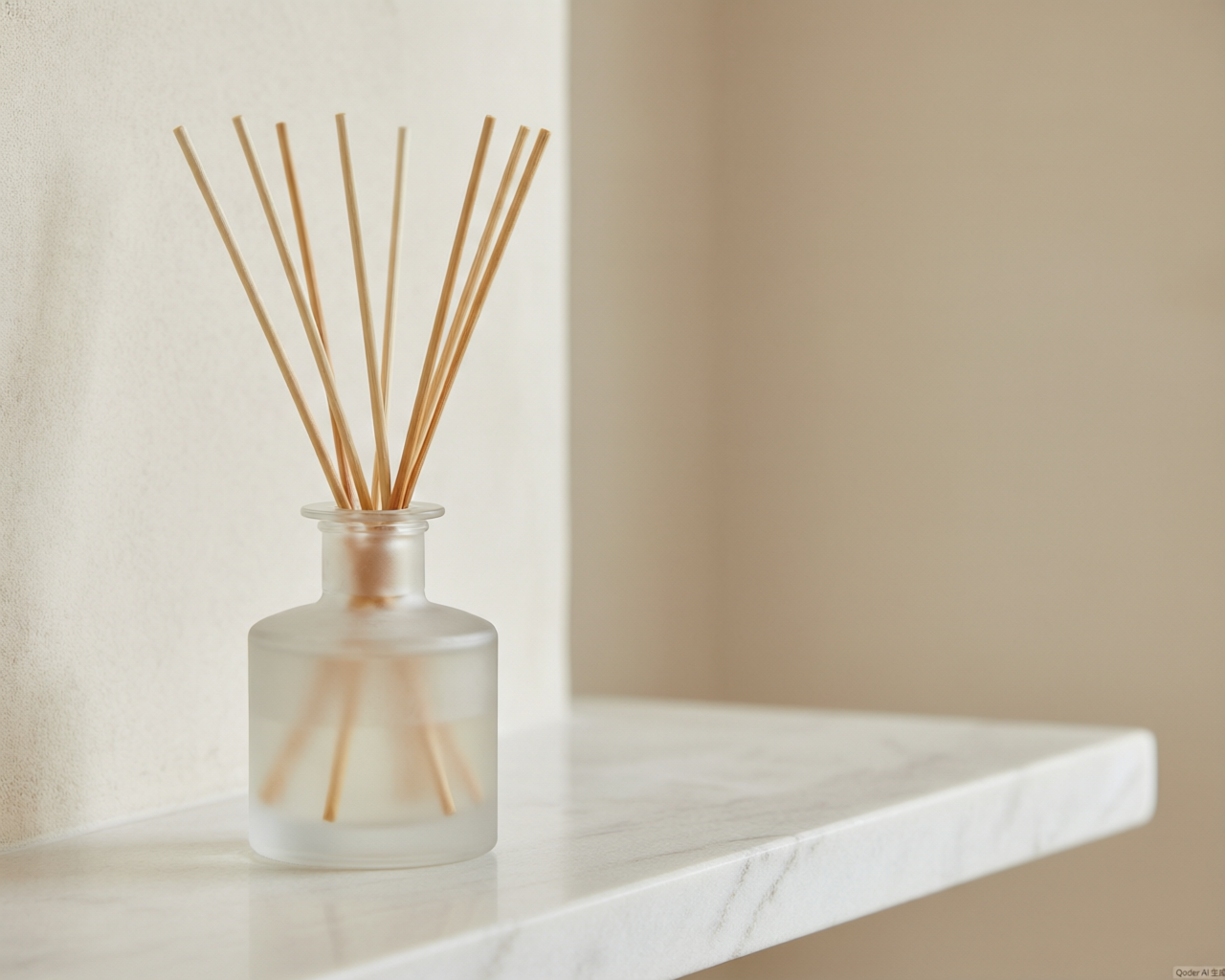
- Reed diffusers — capsules are suspended in the carrier solvent (DPG or isoparaffinic base). You need a suspending agent (fumed silica at 0.5–1.5% w/w) to prevent settling. Standard 3mm fiber reeds clog with capsules above 50 microns; switch to 4–5mm rattan or slotted synthetic reeds.
- Scented candles — capsules are stirred into wax at 55–60 degrees Celsius (below shell degradation temperature). Add at the same stage as fragrance oil, typically 6–10% total load. Expect a 10–15% reduction in cold throw but a 25–40% increase in hot throw duration.
- Car fragrances — capsules are embedded in a polymer matrix (EVA or TPE) during injection molding at 140–160 degrees Celsius. Shell material must withstand processing temperature; specify thermal tolerance above 170 degrees Celsius.
- Room and linen sprays — capsules are added post-emulsification below 30 degrees Celsius. Use a high-shear mixer at 3,000–5,000 RPM for 5 minutes. Nozzle size must exceed 150 microns to avoid clogging.
Lead time impact: encapsulation adds 5–7 working days (in-house) or 12–18 days (third-party capsule sourcing). Factor this into planning for Q4 seasonal launches.
Cost Structure and Pricing Ranges
Understanding the cost stack helps you negotiate effectively with Chinese OEM suppliers. Here is a realistic breakdown for a 200ml reed diffuser at 3,000-unit MOQ:
- Standard fragrance oil load (8% concentration): USD 0.35–0.55 per unit
- Encapsulated fragrance system (6% free oil + 4% encapsulated): USD 0.62–0.95 per unit
- Suspending agent and formulation adjustment: USD 0.04–0.08 per unit
- Additional QC testing (particle size, release curve): USD 0.02–0.05 per unit (amortized)
- Total incremental cost per unit: USD 0.33–0.53
At retail, products marketed with “90-day long release” or “time-release scent” command a 20–35% price premium over standard equivalents. The margin math favors encapsulation for mid-to-premium positioning. Request itemized cost breakdowns from at least three suppliers — some factories bundle capsule cost into a single line item, making benchmarking difficult.
Supplier Vetting Checklist for Chinese OEM Partners
Not every factory advertising “microencapsulation capability” operates an in-house line. Many outsource and add a markup. Use this checklist during qualification:
- In-house capability — ask for photos or video of the encapsulation reactor (typically 500L–2000L stainless steel vessels with high-shear impellers). Factories without this equipment are resellers.
- Particle size documentation — request laser diffraction reports (Malvern Mastersizer or equivalent) for the last five production batches. Consistent D50 within plus-or-minus 10% indicates process control.
- Shell material sourcing — confirm whether melamine-formaldehyde resin is sourced from a named supplier with REACH registration. Unregistered MF resin creates EU compliance risk.
- IFRA and allergen compliance — encapsulation does not eliminate allergen labeling obligations. Verify your supplier provides a full IFRA certificate and EU 26-allergen declaration for the encapsulated system.
- Stability data archive — a credible manufacturer retains 12-month real-time stability data on standard formulations. Ask to see release curves for a product similar to yours.
- Minimum order for custom encapsulation — expect 500 kg minimum for a custom run (approximately 15,000–25,000 finished units). Stock encapsulated fragrances (lavender, citrus, linen) may carry lower MOQs of 200 kg.
For a vetted manufacturing partner with in-house encapsulation and full compliance documentation, explore the OEM program to discuss custom formulation timelines.
Regulatory Considerations by Market
Encapsulated fragrance products face the same regulatory frameworks as conventional fragrance, with additional shell-material considerations:
- EU / UK (CLP + REACH) — melamine-formaldehyde shells must comply with REACH registration. Formaldehyde residual content must be below 75 ppm (E1 threshold) for consumer products. Request a formaldehyde emission test report (EN 717-3) if capsules use MF chemistry.
- USA (TSCA + state-level) — all polymer shell materials must be on the TSCA inventory. California Prop 65 applies if residual formaldehyde exceeds 0.1% by weight. Specify “low-residual” MF resin (below 50 ppm free formaldehyde) to avoid Prop 65 warning labels.
- Australia (AICIS) — new polymer shell chemistries may require AICIS notification. Stick with established shell materials (gelatin, MF, PU) that carry existing registrations.
- Japan (CSCL) — encapsulated products for indoor use fall under the Chemical Substances Control Law. Confirm your supplier can provide a Japanese-language SDS covering both core and shell components.
Build regulatory documentation into your PO terms. Specify that the supplier must deliver IFRA certificate, SDS, allergen declaration, and REACH compliance statement before shipment. Non-compliance at customs adds 3–6 weeks of delay.
Product Applications and Market Positioning
Chinese OEM factories now offer encapsulated fragrance across the full home fragrance range. Review the product catalog for current format options. High-potential applications include:
- Premium reed diffusers — position as “90-day continuous scent.” Pair with a refill program for recurring revenue. Target retail: USD 28–45 per 200ml unit.
- Car fragrance clips — friction-activated capsules release scent when the driver adjusts the vent clip. 45–60 day lifespan. Target retail: USD 8–15 per unit.
- Scented drawer liners and sachets — gelatin-shell capsules activated by opening and closing drawers. 30–45 day effective life. Strong fit for subscription box models.
- Commercial HVAC scenting cartridges — high-load encapsulated beads (200–500 micron) in replaceable cartridges for hotels and retail spaces. 60–90 day replacement cycle drives consumable revenue.
Next Steps
Microencapsulated fragrance technology moves your product line from commodity to performance-driven premium. The engineering is mature, the cost premium is modest, and the retail uplift delivers clear margin expansion. The barrier is supplier qualification and formulation precision.
To move forward:
- Define your target product format, release duration, and trigger mechanism using the comparison table above.
- Prepare a technical brief with specific particle size range, shell material preference, and regulatory market requirements.
- Request samples from at least two qualified OEM factories with in-house encapsulation capability.
- Run 30-day real-time release testing on samples before committing to a production PO.
- Negotiate cost transparency: separate capsule cost, formulation labor, and QC testing in your quotation.
Ready to develop an encapsulated fragrance product? Request a quote with your technical brief attached, and a formulation engineer will respond within 2 business days with feasibility assessment, sample timeline, and itemized pricing. For brands exploring multiple formats, the OEM program offers consolidated development across reed diffusers, candles, car fragrances, and commercial diffuser systems under a single quality framework.