Buying Guides
Electric Diffusers vs Reed Diffusers: Which to Add to Your Range
Dieser Artikel ist noch nicht auf Deutsch verfügbar. Sie lesen die englische Version.

Home fragrance buyers increasingly face a portfolio question: should we stock reed diffusers, electric diffusers, or both? These two categories serve overlapping but distinct consumer needs, carry different margin structures, and present different supply chain considerations. This comparison gives B2B buyers the data to make an informed range decision.
Product Overview
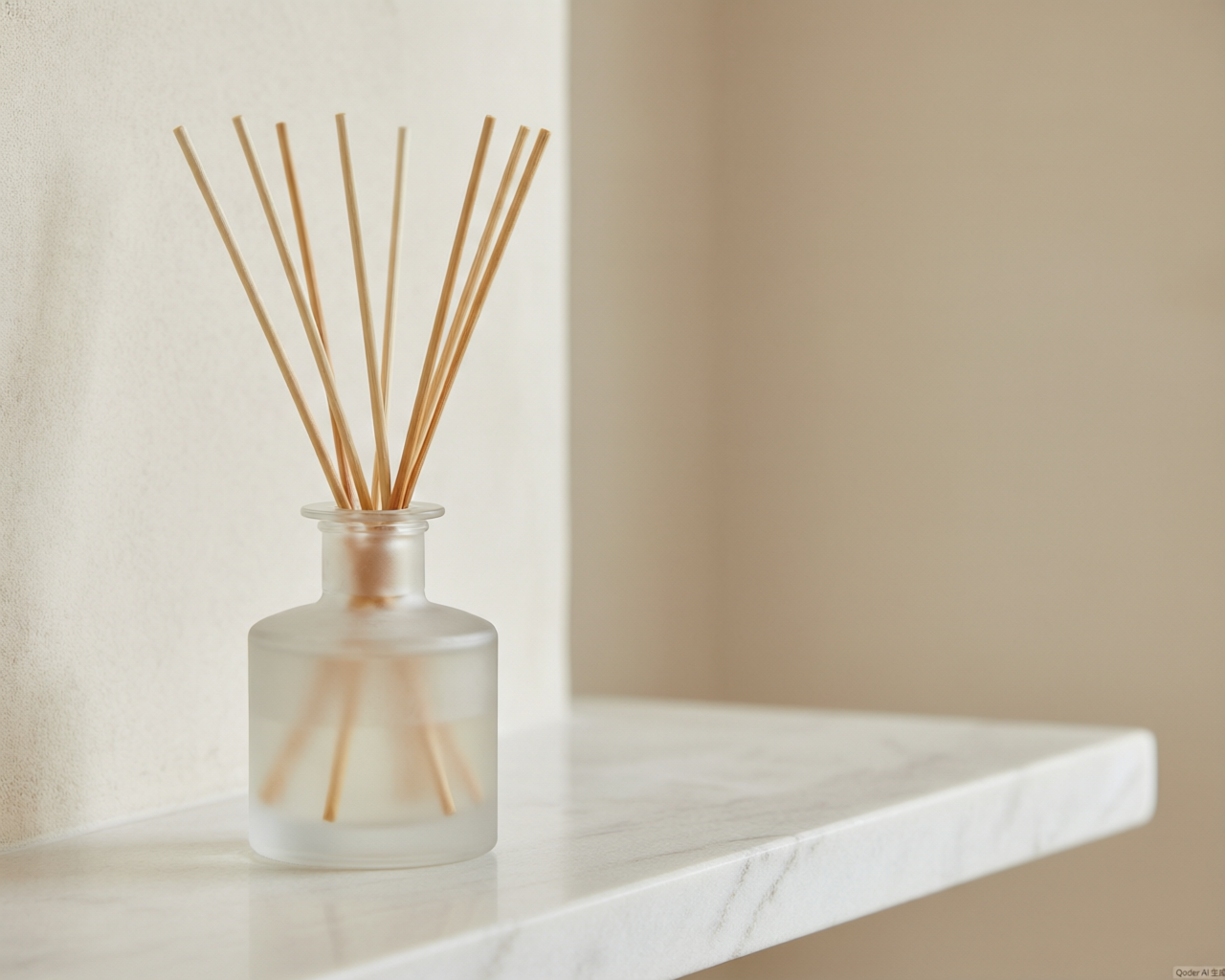
Reed diffusers are passive fragrance delivery systems. A glass vessel holds fragrance oil diluted in a base solvent. Fiber or rattan reeds wick the liquid upward, and scent evaporates from the exposed reed surface. No power, no heat, no moving parts.
Electric diffusers use electricity to disperse fragrance. The category includes:
- Ultrasonic diffusers (water + essential oil, mist output)
- Nebulizing diffusers (pure oil atomized without water)
- Heat-based diffusers (warming plate evaporates oil)
- Fan-based diffusers (airflow passes over a saturated pad or cartridge)
- Smart/connected diffusers (app-controlled, scheduled, HVAC-integrated)
Cost and Margin Comparison
| Parameter | Reed Diffuser (100ml) | Ultrasonic Electric Diffuser | Nebulizing Diffuser |
|---|---|---|---|
| FOB unit cost | $2.80-$5.50 | $6.00-$14.00 | $10.00-$25.00 |
| Retail price | $15-$35 | $30-$70 | $50-$120 |
| Gross margin | 65-80% | 60-75% | 60-72% |
| Consumable revenue | Refill oil every 2-3 months ($4-$8) | Essential oil every 2-4 weeks ($6-$15) | Oil every 3-6 weeks ($8-$18) |
| Product lifespan | 2-4 months (then replace) | 2-5 years (device) | 2-4 years (device) |
Reed diffusers generate repeat purchase revenue through full-unit replacement. Electric diffusers generate consumable revenue through oil refills. Both models support customer lifetime value, but reed diffusers have a simpler reorder path (no compatibility concerns).
Consumer Use Case Comparison
Reed diffusers excel when:
- The consumer wants zero-maintenance, set-and-forget fragrance.
- The space is small to medium (bathrooms, bedrooms, offices up to 20 sq m).
- Aesthetic presentation matters (the vessel is a decor object).
- There is no power outlet available (shelves, bookcases, bathrooms).
- The purchase is a gift (no setup, no instructions, no charging).
Electric diffusers excel when:
- The consumer wants adjustable intensity (timer settings, mist levels).
- The space is large (open-plan living, retail floors, 30+ sq m).
- Aromatherapy or wellness positioning is primary (essential oil purity claims).
- The consumer enjoys ritual and interaction (filling, selecting oils, adjusting).
- Smart home integration is a selling point.
Supply Chain Considerations
Reed Diffusers
- Components: Glass bottle, fragrance liquid, reeds, cap, box. All low-tech, high-availability.
- Lead time: 25-35 days production. No electronic certification.
- Shipping: Liquid goods. Non-DG if flash point above 60 degrees Celsius. No battery regulations.
- QC complexity: Low. Visual inspection, leak test, fill-weight check.
- Defect rate: Typically 1-3% (glass breakage, seal failure).
- Returns risk: Low. No electronics to malfunction.
Electric Diffusers
- Components: Plastic or ceramic housing, PCB, ultrasonic transducer or fan motor, USB cable, packaging. 15-30 individual parts.
- Lead time: 35-50 days production plus 7-14 days for electronic testing.
- Certifications required: CE (EU), FCC (US), RoHS, UL or ETL (if mains-powered). Battery models require UN38.3 and IATA compliance.
- Shipping: Lithium battery models face air freight restrictions and DG surcharges. Mains-powered units ship normally but require plug-type variants per market (US, EU, UK, AU).
- QC complexity: High. Functional testing (mist output, noise level, timer accuracy, auto-shutoff), hi-pot electrical safety test, aging test (24-48 hours continuous run).
- Defect rate: 3-8% depending on factory maturity. Transducer failure and PCB issues are the most common.
- Returns risk: Moderate to high. Electronic failure within warranty creates reverse-logistics cost.
Range Strategy Recommendations
Option A: Reed Diffusers Only
Best for: Brands focused on gifting, decor, and simplicity. Lower operational complexity.
- Start with 4-6 fragrances in 100ml, plus a 50ml travel size.
- Add seasonal limited editions in Q4.
- Introduce refill packs (bottled liquid + reeds) in year two to capture repeat revenue.
Option B: Electric Diffusers Only
Best for: Wellness and aromatherapy brands. Higher AOV but more complex logistics.
- Stock 2-3 device models (compact USB, mid-size mains-powered, premium nebulizer).
- Build a 10-15 SKU essential oil range as the consumable revenue driver.
- Offer device-plus-oil starter kits at a bundled price.
Option C: Both Categories (Recommended for Most Retailers)
Best for: Home fragrance specialists, lifestyle retailers, hospitality suppliers.
- Reed diffusers serve as the entry point and gifting workhorse (60-70% of units sold).
- Electric diffusers serve as the premium upsell and wellness anchor (30-40% of revenue).
- Cross-sell: Display reed diffusers at checkout, electric diffusers at feature displays.
- Shared fragrances: Develop 3-4 signature scents available in both reed and oil format for brand consistency.
Market Data Points
- Global reed diffuser market: approximately $1.2 billion (2024), growing at 5-6% CAGR.
- Global electric diffuser market: approximately $1.8 billion (2024), growing at 8-10% CAGR.
- Reed diffusers dominate in gifting channels (70%+ of gift set purchases).
- Electric diffusers dominate in wellness and aromatherapy channels (65%+ share).
- Average reed diffuser buyer age: 28-55, skewing female (72%).
- Average electric diffuser buyer age: 22-45, more balanced gender split (60% female).
Practical Sourcing Tips
- If adding electric diffusers to an existing reed range: Source from a factory experienced in both categories. Aromiso and similar manufacturers offer combined catalogs, simplifying QC, shipping consolidation, and payment terms.
- Certification budget: Allocate $2,000-$5,000 per electric diffuser SKU for CE/FCC/RoHS testing if the factory does not already hold valid certificates.
- Warranty terms: Negotiate a 12-month warranty with the factory covering electronic defects. Agree on a defective-unit replacement ratio (typically 2-3% spare units shipped free).
- Packaging harmonization: Use the same box supplier and print standards for both categories to maintain brand consistency and reduce setup costs.
- Test market first: Launch electric diffusers in 2-3 SKUs before committing to a full range. Track return rates and sell-through for 90 days before scaling.
Final Verdict
Reed diffusers are the lower-risk, higher-margin, simpler-to-operate category. Electric diffusers offer stronger growth rates and consumable revenue but demand more supply chain management. For most B2B buyers, reed diffusers should form the portfolio foundation, with electric diffusers added as a complementary premium line once the core business is stable.