Market Guides
Private Label Candle Manufacturing for US Brands: A Sourcing Guide
Este artículo aún no está disponible en español. Lo estás viendo en inglés.
Private label is the dominant model for US candle brands that want retail-quality product without capital expenditure on pouring lines, fragrance labs, and warehousing. China supplies an estimated 60 to 70 percent of the candles imported into the United States each year, and the gap between a good OEM partner and a mediocre one shows up directly in customer reviews and return rates. This guide explains how US brands should evaluate, contract, and scale with a Chinese private-label candle manufacturer.
Why US Brands Choose Private Label
Three economics drive the decision:
- Capital avoidance — A domestic candle production line costs USD 150,000 to USD 500,000 to set up. Private label converts that into a per-unit cost.
- Speed to market — A new SKU can launch in 60 to 90 days from brief to warehouse, versus 6+ months for in-house development.
- Fragrance breadth — Established OEMs maintain libraries of 200+ IFRA-compliant fragrances, which would cost a startup years to develop.
The trade-off is control. Brands surrender formulation, scheduling, and quality execution to the factory, which is why supplier selection matters more than price negotiation.
Evaluating a Private-Label Candle Factory
Score every candidate against these criteria:
Manufacturing Capability
- Wax platforms: soy, coconut-soy, paraffin, beeswax, blends
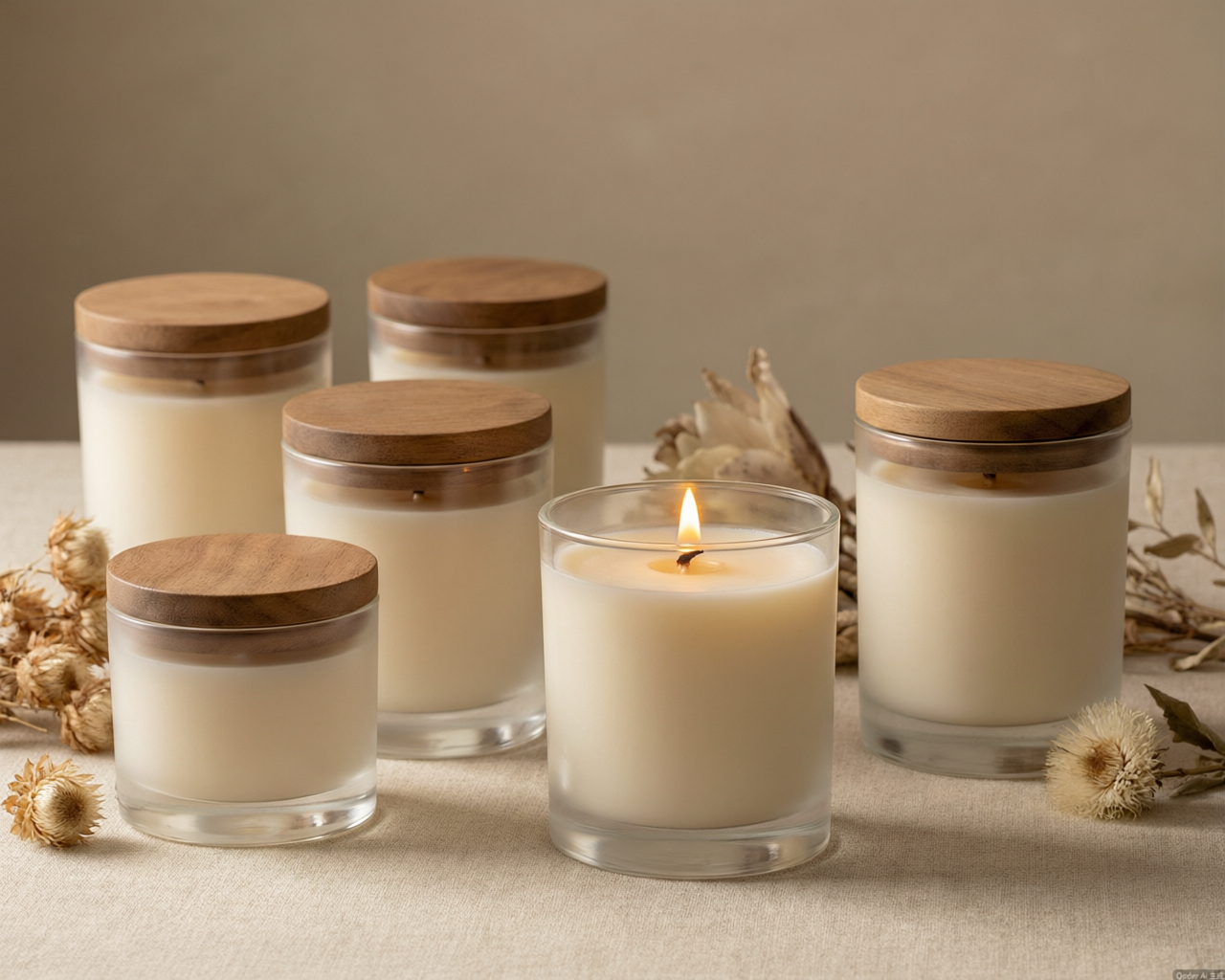
- Vessel range: glass jars, tins, ceramics, concrete, custom molds
- Wick options: cotton, wood, zinc-core (note: lead-core wicks are banned under CPSC since 2003)
- Fragrance load capacity: typically 6 to 12 percent for container candles
- Daily output: a credible OEM should pour 10,000+ units per day
Quality and Compliance
- ISO 9001 certification
- ASTM F2417 burn testing in-house or via accredited lab
- IFRA-compliant fragrance sourcing
- SDS and Prop 65 documentation as standard deliverables
- Sedex, BSCI, or SMETA audit history
- Defect rate commitment, typically below 2 percent
Commercial Terms
- MOQ: 500 to 1,000 units per SKU is standard for custom private label; some factories accept 300 for stock vessels
- Sample fee: USD 50 to USD 200 per scent, usually credited against bulk order
- Deposit: 30 percent T/T, balance against bill of lading copy
- Lead time: 30 to 45 days production after sample approval
- Payment currency: USD; some factories accept RMB at a negotiated rate
Structuring the OEM Agreement
A solid private-label contract with a Chinese factory should cover:
- Product specification sheet — wax blend, fragrance load, wick type, vessel dimensions, net weight tolerance (typically plus or minus 5 percent).
- Approved sample reference — a sealed, signed unit held by both parties.
- Quality standards — AQL 2.5 for major defects, 4.0 for minor, with inspection rights.
- Compliance deliverables — SDS, IFRA, ASTM F2417 reports, Prop 65 evaluation.
- IP and exclusivity — ownership of custom fragrance formulas, molds, and artwork.
- Penalty clauses — late shipment (typically 0.5 percent per week, capped at 5 percent), defect remediation, and rejection rights.
- Dispute resolution — arbitration through CIETAC (China) or HKIAC (Hong Kong) is more enforceable than US courts.
Brands scaling past USD 500,000 in annual purchases should add a most-favored-customer pricing clause and annual cost-review mechanism tied to raw material indices.
Cost Structure of a Private-Label Candle
For an 8 oz soy candle in a custom-printed glass jar with retail box, FOB Shenzhen pricing in 2025 typically breaks down as:
| Component | Approximate cost |
|---|---|
| Glass vessel and lid | USD 0.55 to USD 0.95 |
| Wax blend (soy/coconut) | USD 0.50 to USD 0.80 |
| Fragrance oil at 8 percent load | USD 0.40 to USD 0.90 |
| Wick, wick sticker, centering device | USD 0.10 to USD 0.20 |
| Label and retail box | USD 0.30 to USD 0.60 |
| Labor, overhead, factory margin | USD 0.65 to USD 1.05 |
| FOB unit cost | USD 2.50 to USD 4.50 |
Add ocean freight, duty (candles enter under HS 3406.00.00 duty-free under MFN, but Section 301 tariffs may add up to 25 percent), customs brokerage, and drayage, and the landed cost typically lands between USD 3.20 and USD 5.80.
Managing the First Production Run
A practical sequence for the first order:
- Approve final sample in writing with photos and signed unit.
- Issue purchase order referencing the spec sheet and contract.
- Pay 30 percent deposit; production begins.
- Schedule pre-shipment inspection at 80 percent completion (USD 250 to USD 400 per man-day through SGS, Intertek, or QIMA).
- Approve inspection report; pay balance.
- Receive shipping documents (commercial invoice, packing list, bill of lading, certificate of origin).
- Customs broker files entry; cargo clears in 3 to 7 days.
- Receive at 3PL; perform incoming QC on a random sample.
Scaling to Repeat Orders
Once the first SKU proves out, scale by:
- Adding 2 to 3 scents per quarter, not all at once
- Negotiating tiered pricing at 5,000, 10,000, and 20,000 unit thresholds
- Establishing a rolling 90-day forecast with the factory to lock fragrance oil inventory
- Building dual-source capability for the top SKU once volume exceeds 50,000 units per year
At Aromiso, repeat-order clients receive dedicated account management, locked fragrance formulas under NDA, and quarterly cost reviews tied to wax and fragrance oil indices.
Final Thoughts
Private-label candle manufacturing is a relationship business dressed up as a procurement exercise. US brands that win treat the factory as a co-developer, invest in proper contracts and inspections, and resist the race-to-the-bottom pricing that produces 5 percent defect rates and Amazon review disasters. The cost difference between a good OEM and a cheap one is small per unit and enormous over a brand’s lifetime.